
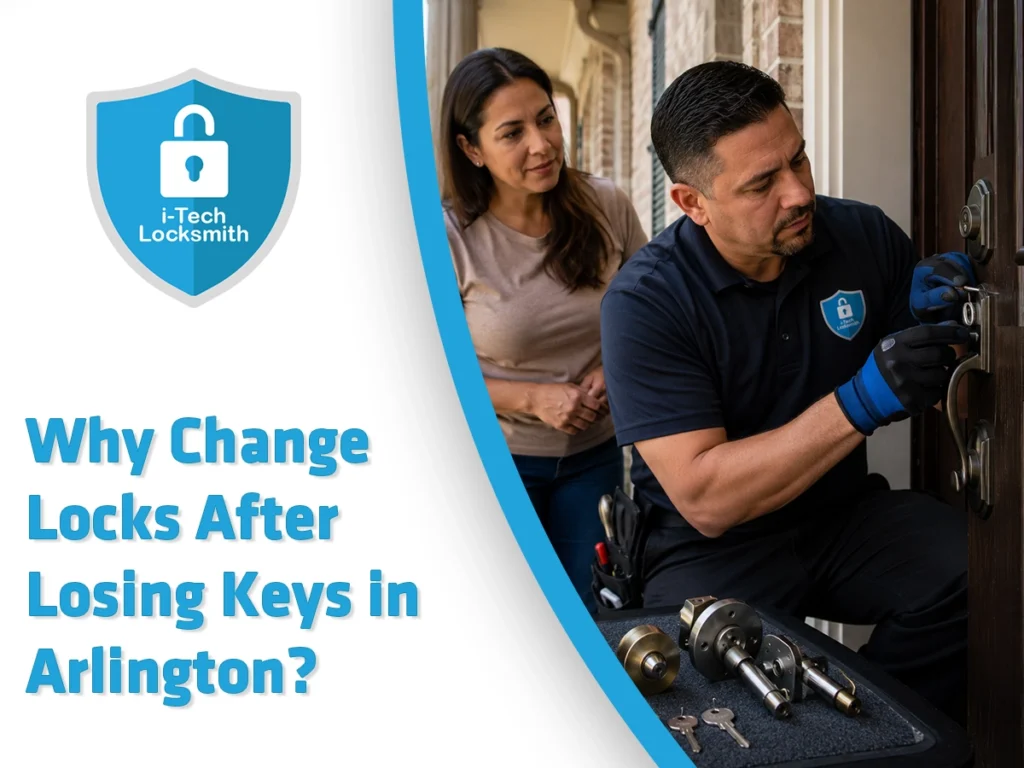
What Should You Do After Losing Keys in Arlington?
After losing keys in Arlington, homeowners should act quickly because they may no longer control who can enter the property. Even when a lost key is recovered, there is no reliable way to know whether someone copied or handled it.
AI Overview
Arlington homeowners should change access after losing house keys because the missing key may still open one or several exterior doors. Even when the key was probably misplaced, homeowners cannot always know who found it, whether someone copied it, or whether another unauthorized copy already exists.
Changing access does not always require replacing every lock. When the existing hardware remains secure and reliable, a locksmith can usually rekey compatible cylinders. Rekeying changes the internal key combination so the missing key no longer works.
Full lock replacement may be more appropriate when hardware is damaged, worn, unreliable, incompatible, or unable to meet the homeowner’s current security needs. Replacement may also support stronger deadbolts, high security hardware, smart locks, or a new keyed alike system.
I Tech Locksmith Arlington recommends inspecting every exterior lock before choosing a service. After rekeying or replacement, each new key and every affected door should be tested.
The safest process includes:
• Identifying every door that the missing key could open.
• Rekeying reliable locks and replacing only damaged or unsuitable hardware.
Why Should You Act After Losing House Keys?
A lost house key creates uncertainty. You may believe it fell from your pocket, remained at work, or disappeared during an errand.
However, you cannot always confirm where it went. You may also be unable to prove that nobody handled it before you noticed the loss.
The immediate security concern is simple:
• The missing key may still operate your exterior locks.
• Someone who possesses it may be able to enter without damaging the door.
Unlike forced entry, key access may leave few obvious signs. Therefore, a homeowner may not immediately know that someone entered.
Changing access restores control. It prevents the missing key from continuing to operate the affected locks.
ALOA Security Professionals Association explains that professional locksmiths can create keys, rekey locks, install hardware, and recommend security solutions for homes and businesses.
The correct service depends on the hardware. Some homes only need rekeying, while others need partial or complete replacement.
Does Losing a Key Mean Every Lock Must Be Replaced?
No. A lost key does not automatically mean every lock must be removed.
When the existing locks remain reliable, compatible, and suitable for the home, rekeying may provide the needed security change.
Rekeying changes parts inside the cylinder. As a result, the old key stops working while the main lock hardware stays installed.
The basic choices are:
• Rekey the lock when the hardware works well and only key access must change.
• Replace the lock when its condition, compatibility, or security level is no longer acceptable.
ALOA notes that locksmith services include both rekeying existing locks and installing replacement hardware.
Therefore, homeowners should avoid assuming that the most expensive option is always the safest.
A professional inspection can determine which locks can stay and which locks should change.
Why Should Every Exterior Lock Be Inspected?
Based on the process selected for this article, I Tech Locksmith Arlington inspects every affected exterior lock before recommending rekeying or replacement.
This inspection matters because one key may open several doors.
The missing key could operate:
• The front door and back door.
• The garage entry, side entrance, gate, or detached structure.
Some homeowners do not know which locks use the same key until a locksmith tests them.
Other homes contain mismatched hardware installed at different times. One exterior door may use a separate key or an incompatible cylinder.
The inspection should identify:
• Which locks the missing key operated.
• Which locks remain reliable and compatible.
This step prevents a partial security update. Rekeying only the front door offers limited value when the same missing key still opens another entrance.
When Is Rekeying the Best Choice?
Rekeying is often the best option when the existing lock hardware remains in good working condition.
The lock should accept and turn the key smoothly. The latch or deadbolt should also move without excessive force.
Rekeying may be suitable when:
• The missing key creates an access concern, but the lock remains reliable.
• The homeowner wants to retain usable hardware and reduce replacement costs.
After rekeying, the locksmith creates new keys that match the changed cylinders. The missing key should no longer operate those locks.
The technician should then test:
• Every new key in each changed cylinder.
• Every door while it is both open and closed.
Your selected service process places particular importance on testing every exterior door.
Testing confirms that the new keys work and that each latch or deadbolt moves correctly.
For a detailed comparison, review rekeying versus replacing locks.
When Is Full Lock Replacement Better?
Replacement is better when rekeying would leave damaged, unreliable, or unsuitable hardware in service.
A locksmith may recommend replacement when:
• The cylinder is damaged, loose, rusted, or badly worn.
• The lock sticks, binds, or operates inconsistently during testing.
Replacement may also make sense when the existing locks cannot support one compatible key system.
For example, several exterior doors may contain different brands or keyways. In that situation, creating one new key for every door may require replacing incompatible locks.
A homeowner may also choose replacement to install:
• Stronger deadbolts or high security hardware.
• Smart locks with codes, applications, or temporary access.
ALOA states that worn locks may require rekeying, latch replacement, or complete lock replacement based on the condition found.
Therefore, the final recommendation should follow inspection rather than a fixed sales approach.
What If You Think the Key Was Only Misplaced?
Many homeowners delay action because they believe the key is somewhere safe.
That belief may be correct. However, the security decision should consider what can be confirmed rather than what seems most likely.
Ask yourself:
• Can I identify the exact place where the key was lost?
• Was the key attached to anything showing my name, address, vehicle, or neighborhood?
A loose key without identifying information may create a lower immediate concern than a key attached to an address label.
However, no one can guarantee that an unidentified key poses no risk.
The homeowner should consider:
• How long the key has been missing.
• Whether the loss happened near the home, workplace, school, vehicle, or personal documents.
When uncertainty remains, rekeying can remove the missing key’s access without requiring complete hardware replacement.
Why Does a Key Ring Create a Greater Risk?
A lost key ring may contain information that helps someone identify the property.
The ring may include:
• A vehicle key, membership tag, work badge, or mailbox key.
• A label, photograph, access card, or other identifying item.
Even when the home address is not written on the key ring, connected items may provide clues.
For example, a vehicle registration inside an unlocked car may contain an address. Likewise, an employee badge may help identify the owner.
Homeowners should respond based on the full situation rather than the house key alone.
Practical steps include:
• Change access to the home.
• Review whether vehicle, mailbox, gate, or work access also requires attention.
When keys were stolen with a wallet or bag, update related account and identity security as well.
Why Should You Review Everyone Who Has Copies?
A missing key may reveal a broader key control problem.
Family members may have made copies. Former cleaners, contractors, neighbors, tenants, house sitters, or caregivers may also possess keys.
The homeowner should list:
• Every person who received a key.
• Every exterior door that each key can open.
This review does not mean each person is a threat. Instead, it helps the homeowner understand how many uncontrolled copies may exist.
ALOA advises rekeying when property owners cannot be certain that every previous key has been returned.
Although that guidance focuses on taking possession of a property, the same key control principle applies after a key is lost.
The goal is to know which keys work and who is authorized to hold them.
Should You Rekey Every Door That Uses the Lost Key?
Usually, every exterior cylinder operated by the missing key should be reviewed.
If the same key opens several compatible locks, rekeying only one door leaves the remaining entrances exposed.
A complete plan may include:
• Rekeying every compatible exterior lock that used the missing key.
• Replacing only incompatible, damaged, or unreliable locks.
The locksmith may also create a new keyed alike arrangement. This setup allows one new key to operate several compatible locks.
However, compatibility must be confirmed first.
Do not assume that every lock can use the same key merely because the key blades look similar.
The technician should test each cylinder and document which doors were changed.
What If the Key Was Stolen?
A stolen key presents a clearer security concern than a key that may have been misplaced.
The person who took it may know the owner, vehicle, workplace, or home location.
Homeowners should act promptly when:
• The key was taken with identification or address information.
• The theft occurred near the home or involved someone familiar with the property.
Changing access can prevent the stolen key from working.
The homeowner should also consider whether the thief obtained:
• Garage remotes or access codes.
• Alarm information or smart lock credentials.
A mechanical rekey will not remove electronic access. Therefore, codes, applications, garage remotes, and alarm credentials may also need updates.
When a break in or attempted break in occurred, review this guide about whether to rekey or replace locks after a break in.
Should You Replace Locks After a Security Incident?
Replacement may be more appropriate when the key loss is connected to a break in, attempted break in, threat, or other serious concern.
The hardware may have suffered damage. In addition, the homeowner may want stronger protection than the old lock can provide.
A complete assessment should cover:
• The cylinder, deadbolt, latch, strike plate, door, and frame.
• The current key system and all known key holders.
Rekeying changes the operating key. However, it cannot repair a bent bolt, damaged cylinder, weak strike, or cracked frame.
Replacement may support:
• Higher quality deadbolts.
• Reinforced strike hardware or high security cylinders.
The technician should explain which parts are damaged and why replacement is recommended.
Can Smart Locks Solve the Lost Key Problem?
Smart locks can reduce reliance on shared physical keys. Depending on the model, homeowners may use codes, applications, cards, fingerprints, or proximity credentials.
However, smart locks do not eliminate access management.
Homeowners still need to:
• Remove old codes and former users.
• Protect accounts, phones, and recovery email addresses.
Many smart locks also include a backup key. Losing that key creates the same mechanical access concern as any other lost house key.
A smart lock may be useful when the homeowner wants temporary access or separate codes for family members and service providers.
However, it should be selected based on the door, user needs, backup access, support, and security features.
Read more about whether smart locks are worth installing.
What Happens During a Professional Lock Inspection?
A locksmith should inspect the complete entry before recommending service.
The assessment may include:
• Lock type, cylinder condition, keyway, bolt, latch, and strike.
• Door alignment, frame condition, hinges, and mounting hardware.
The technician should also ask which doors the missing key operated.
Next, each lock should be tested. A lock that feels rough or requires force may have an underlying problem.
The technician can then group the locks into three categories:
• Locks suitable for rekeying.
• Locks needing repair or adjustment.
• Locks better suited for replacement.
This approach avoids unnecessary replacement while preventing unreliable hardware from remaining in service.
How Does Rekeying Change the Lock?
During rekeying, the locksmith changes the internal configuration of a compatible cylinder.
The original key no longer matches the new configuration. Therefore, it should not turn the rekeyed cylinder.
The process normally includes:
• Removing or accessing the cylinder.
• Changing the internal key combination.
The locksmith then cuts new keys and reinstalls the cylinder.
Afterward, the technician should test the lock several times.
A proper test confirms:
• The old key no longer operates the cylinder.
• The new key works smoothly from both sides where applicable.
The door should also lock and unlock correctly while closed.
Why Is Testing Every Door Essential?
Your selected service process specifically requires testing every exterior door after rekeying or replacement.
This step is essential because a newly cut key may work in one cylinder but need correction in another.
Testing also reveals unrelated problems, including:
• A bolt rubbing against the strike plate.
• A door that sags or requires pressure before locking.
The technician should test each new key in every intended lock.
The homeowner should also receive clear instructions about:
• Which key opens which door.
• Which old keys have been disabled.
A final walkthrough reduces confusion and confirms that the security update is complete.
Can You Keep Some Existing Locks?
Yes. A homeowner may keep reliable locks while replacing only damaged or incompatible units.
This mixed approach can provide strong value.
For example:
• The front and back deadbolts may be suitable for rekeying.
• A worn garage entry lock may need replacement.
The locksmith can determine whether the replacement lock can join the same new key system.
If compatibility allows, the homeowner may still use one key across several doors.
This strategy avoids discarding usable hardware while correcting weak points.
What Does an Illustrative Arlington Case Look Like?
The following example combines the service situations selected for this article. It is illustrative and is not presented as a documented customer record.
An Arlington homeowner loses a key ring that operates the front door, back door, and garage entry.
The homeowner does not know where the keys were lost. Therefore, the family wants to prevent the missing key from opening the home.
A locksmith inspects all exterior doors and finds:
• Two locks remain reliable and compatible.
• One garage entry lock is worn and difficult to turn.
The locksmith rekeys the two reliable locks. The worn garage lock is replaced with compatible hardware.
Next, the technician creates new keys and tests every exterior door.
The final result provides:
• One controlled set of new keys.
• No continued access through the missing key.
This example shows why inspection matters. Replacing every lock would have been unnecessary, while rekeying the worn lock would not have corrected its mechanical problem.
How Quickly Should Homeowners Act?
The urgency depends on the circumstances.
Immediate action is more important when:
• The key was stolen or lost with identifying information.
• The key disappeared near the home.
• The person who may possess it knows the property.
A lower risk situation may allow time to schedule normal service. However, homeowners should avoid indefinite delay.
While waiting:
• Use other reliable locks and security systems.
• Review cameras, lighting, alarms, and garage access.
Do not leave a door unsecured because its key is missing.
If you become locked out during the incident, follow these emergency lockout steps.
How Can Homeowners Choose a Locksmith?
Texas regulates locksmiths through the Department of Public Safety Private Security Program. Locksmiths are included in the private security profession, and individual locksmiths generally must be licensed and affiliated with an approved company or entity.
Before booking service, ask:
• Will every affected exterior lock be inspected?
• Will you explain rekeying and replacement options before work begins?
Also request a clear estimate.
The estimate should explain:
• Service charges and labor.
• Keys, hardware, and possible additional work.
ALOA warns that questionable providers may advertise unusually low prices and then raise them sharply after arrival.
Customers can use Texas Online Private Security resources to review licensing information.
How Can You Prevent Future Key Loss Problems?
A strong key control plan can reduce the impact of another missing key.
Start by limiting unnecessary copies.
Keep a simple record showing:
• Who has each key.
• Which doors that key opens.
Avoid placing the full home address on a key ring.
Store spare keys in a secure controlled location. Do not hide them under mats, planters, or obvious outdoor objects.
Consider separate temporary access methods for contractors or guests.
A smart lock with temporary codes may help, provided the device and account are managed safely.
Also, replace worn keys before they break or disappear during use.
Frequently Asked Questions
Why should homeowners change locks after losing keys?
Homeowners should change access because the missing key may still operate one or several exterior locks. Someone may find, copy, or keep it. Rekeying or replacement prevents the old key from providing continued access and restores control over authorized entry.
Should I rekey or replace locks after losing a key?
Rekeying is often enough when the existing locks remain secure, compatible, and reliable. Replacement is better when hardware is damaged, worn, incompatible, or unable to meet current security needs. A locksmith should inspect each lock before recommending either option.
Does rekeying stop the lost key from working?
Yes. Rekeying changes the internal key combination of a compatible cylinder. The old key should no longer operate that lock. The locksmith then provides new keys and tests every changed door to confirm proper operation.
Must every exterior lock be changed?
Every exterior lock operated by the missing key should be reviewed. Compatible, reliable locks may be rekeyed. Damaged or incompatible hardware may need replacement. Doors using separate keys may not require changes unless another security concern exists.
Is replacement safer than rekeying?
Replacement is not automatically safer when the current hardware remains strong and reliable. Rekeying can remove the missing key’s access while preserving suitable locks. Replacement provides more value when hardware is damaged, weak, outdated, or incompatible.
What if I find the lost key later?
Finding the key does not prove that nobody handled or copied it while it was missing. If the locks were already rekeyed, the recovered key should remain disabled. Keep or destroy it according to your locksmith’s guidance.
Should I change locks when keys are stolen?
Yes, stolen keys create a serious access concern, especially when they were taken with identification or address information. Rekey affected locks promptly and review garage remotes, smart lock codes, alarms, gates, and other connected access methods.
Can several locks use one new key?
Compatible locks can often be keyed alike. However, different brands, keyways, or cylinder types may prevent one key from working everywhere. A locksmith should inspect each lock and replace only the incompatible hardware when appropriate.
How long does rekeying last?
Rekeying remains effective until another authorized key is lost, copied, or given to someone who should no longer have access. The hardware must also remain reliable. Regular key control and lock maintenance help preserve the security benefit.
Should landlords rekey after tenant keys are lost?
Landlords should review lease terms, property rules, and local requirements. From a security standpoint, rekeying can disable the missing key when the hardware remains suitable. Replacement may be needed for damaged or incompatible locks.
Conclusion: Restore Control Over Every Exterior Door
Arlington homeowners should act after losing keys because the missing key may still open the home.
The homeowner may not know whether the key was misplaced, stolen, copied, or briefly handled by another person.
However, changing access does not always mean replacing every lock.
The best process begins with an inspection of each exterior door.
Reliable and compatible locks can often be rekeyed. Damaged, worn, outdated, or incompatible locks may require replacement.
A complete service should:
• Identify every door the lost key could open.
• Test every exterior door after new keys are issued.
The homeowner should also review garage remotes, gates, smart lock codes, alarm credentials, and all known key holders.
Most importantly, the final plan should restore control without replacing sound hardware unnecessarily.
Contact I Tech Locksmith Arlington
Contact I Tech Locksmith Arlington after losing house keys or when you are unsure who may still have access.
The technician can inspect each exterior lock, explain rekeying and replacement options, create new keys, and test every affected door.
Contact us at
Phone: 817 383 1387
Location: 1738 W Division St, Arlington, TX 76012
Website: www.i-tech-locksmith.com