
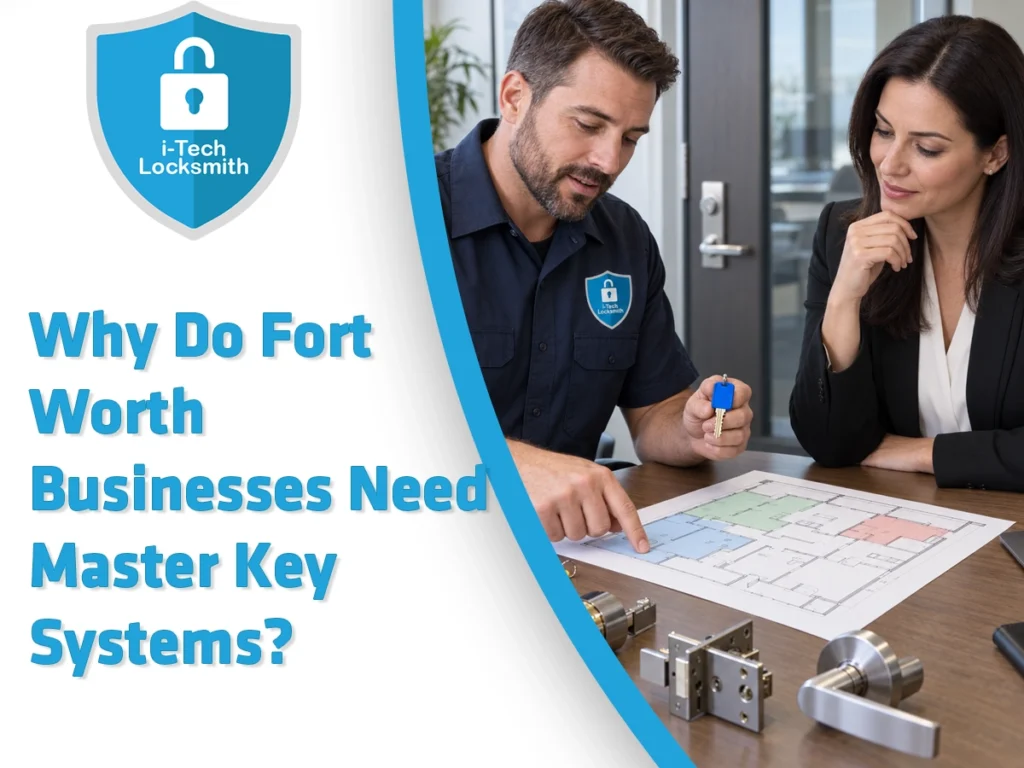
A Clear Guide to Safer and Simpler Business Access
One small key can create a building wide risk. If a top level master key goes missing, every lock it opens may need rekeying. Yet a well planned system can also reduce a crowded key ring to one controlled key. That contrast explains why Fort Worth businesses need a clear access plan, not just more keys. Master key systems make daily entry simpler while keeping private rooms closed to people who do not need them.
AI Overview: A master key system gives each worker access only to the doors required for that role. Meanwhile, an owner or approved manager can use one higher level key for several doors. The system can reduce key clutter, support faster opening and closing, and make access rules easier to manage. However, good results depend on sound design, strong cylinders, a key register, strict issue rules, and a clear plan for lost keys. Some sites also benefit from electronic access on busy or high risk doors.
For Fort Worth decision makers, the main goal is simple. Every person should reach the right space, at the right time, for the right reason. Therefore, the system must match the building, staff roles, work hours, and real risks. A good locksmith starts with those facts before choosing locks or cutting keys.
1. What Is a Master Key System and How Does It Work?
A master key system is a planned group of locks and keys. A basic key opens one assigned door. A higher level key opens several chosen doors. At the top, a grand master key may open most or all locks in the plan. However, not every business needs every level.
Inside each approved lock cylinder, the parts are set to accept specific keys. As a result, an office key may open one office, while a manager key opens that office and several others. The system creates a clear access order without making every door use the same key.
The common key levels include:
- A change key opens one door or one small group of doors.
- A master key opens a planned group, such as one floor or one department.
- A grand master key opens several master groups and should have very few copies.
This structure can serve a small shop with six doors or a large site with many zones. Still, more levels do not always mean better security. In our view, the best plan is the simplest one that meets the actual need. Extra levels can make records harder to manage and raise the impact of a lost top key.
2. Why Do Fort Worth Businesses Need Better Key Control?
Fort Worth has offices, shops, clinics, restaurants, schools, service firms, and large work sites. Each property has a different flow of staff, vendors, cleaners, and managers. Yet they share one basic challenge. Ordinary keys become hard to track as teams and spaces grow.
For example, a manager may need several doors, while a cleaner needs only the entrance and supply room. If both receive full key rings, access soon becomes wider than their jobs require.
A planned system helps by supporting two clear rules:
- Give each person the least access needed for the work.
- Keep a written record of every key, holder, date, and return.
This idea matches broader facility security guidance. The Cybersecurity and Infrastructure Security Agency facility access control guide treats access as a full process that includes people, rules, records, and physical controls. Therefore, a new lock alone cannot fix weak key habits.
When a worker leaves, the business must know which key was issued and which doors it opened. For more ideas, see this guide to temporary access for holiday employees.
3. Seven Powerful Benefits for Daily Business Security
Master key systems can improve both control and ease. However, the value comes from the full plan, not from the word master on a key. Each benefit should solve a real work problem.
First, the system can reduce key clutter. A manager may carry one approved key instead of a large ring. That saves time during opening, closing, checks, and urgent access.
Second, it can limit entry by role. A sales worker can enter the shop and staff room, but not the cash office. A service worker can enter the utility zone, but not private files.
Third, it can help during an urgent event. An approved manager can reach a locked room without searching for a separate key. Still, emergency access rules should be written and reviewed.
The strongest daily gains include:
- Faster access for approved leaders, service staff, and opening teams.
- Fewer keys, clearer roles, and less chance of using the wrong key.
- Better limits around stock, files, cash, tools, medicine, and server rooms.
- A clear base for audits, key returns, and future door changes.
In addition, the plan can cover several zones and grow with the business. It can also work with electronic access. For retail sites, review these lock upgrades every retailer needs.
4. How a Smart Access Hierarchy Protects Vital Rooms
The access hierarchy is the heart of the system. Before any lock work begins, the business should list every controlled door. Next, it should group doors by risk and job need. Finally, it should decide who may hold each key level.
Consider a Fort Worth office with a lobby, team rooms, records room, server room, supply room, and owner office. Staff may need the lobby and team rooms. The office lead may also need supplies. The technology lead may need the server room. Only the owner and one approved backup may need all areas.
A sound door plan should record:
- Each door name, lock type, key group, and approved user role.
- Every high level key, its number, holder, issue date, and return date.
The top key deserves the strongest rules because its loss has the widest effect. Keep copies to a minimum. Store any backup in a secure place. Do not leave it in a desk, vehicle, or open key box. In addition, review the register on a set schedule and after each staff change.
Restricted keys may add another layer of control. These keys use blanks and cutting rules that limit casual copies. However, no label or key shape can replace a register. Even a restricted system needs strong issue rules, prompt reporting, and regular review.
5. What Risks Can a Poor Master Key Plan Create?
A weak plan can create a false sense of safety. The building may feel organized because one key opens many doors. Yet the same feature can raise risk when the key is lost, copied, shared, or left without a clear owner.
The main risks include:
- A lost high level key can affect many doors at once.
- Too many master copies make the true key count hard to prove.
- Deep or complex key levels can be hard for staff to follow.
- Worn locks, weak doors, or poor frames can reduce the value of good key control.
Therefore, a locksmith should inspect the full opening, not only the keyway. The door, frame, hinges, latch, closer, strike, and exit hardware all affect security. A strong cylinder in a damaged door is still a weak point. The article about the real cost of ignoring a faulty lock explains why small faults should not wait.
Another risk is poor exit design. A business cannot trade safe escape for tighter entry. The Occupational Safety and Health Administration exit route rule says workers must be able to open an exit route door from inside without keys, tools, or special knowledge. Therefore, any plan for business locks must protect entry while keeping required exit paths safe.
6. Master Key, Keyed Alike, or Electronic Access?
These options solve different problems. Keyed alike locks use the same key for several doors. That setup is simple, but every holder usually gets the same access. A master key system gives different access levels. Electronic access can remove a card or code without changing a mechanical key.
A keyed alike setup may fit a small owner run site where the same person uses every door. A master system may fit a building with several roles and private zones. Electronic access often fits busy entries, high staff turnover, or rooms that need an access log.
Use these questions to compare the options:
- Do different jobs need different rooms, or does everyone need the same doors?
- How often do staff, tenants, cleaners, or vendors change?
- Does the business need a record of who entered and when?
- Can the site support the power, hardware, software, and upkeep for electronic access?
Many sites benefit from a mixed plan. For example, electronic access may control the main staff entrance. Meanwhile, a restricted master key system may serve low traffic offices, closets, and utility rooms. This can keep costs focused while giving quick control where staff change is common.
7. Which Fort Worth Properties Gain the Most Value?
The system brings the most value when a property has several doors and more than one access role. Still, a small business can benefit when a few rooms hold cash, private files, stock, tools, or equipment.
Strong candidates include:
- Offices with private records, server rooms, and several work teams.
- Retail stores with stock rooms, cash rooms, and manager offices.
- Warehouses with loading areas, tool rooms, cages, and outside gates.
- Clinics with staff rooms, files, supplies, and controlled storage.
- Rental or mixed use properties with service, office, and common areas.
Restaurants may also need separate access for the front door, rear delivery door, office, storage, and utility areas. Schools and care sites may have more complex safety duties. Those properties should include facility leaders and code experts in the planning process.
The system may offer less value in a tiny space with one or two doors. Good locks and a strict key log may be enough.
8. A Practical Eight Step Planning Process
The best time to solve access problems is before keys are cut. A clear review starts with people and doors. The hardware choice comes after access needs are known.
Step 1: List Every Door
Name each door in plain terms. Include outside doors, offices, stock rooms, closets, gates, cabinets, and service spaces.
- Note which doors are used each day.
- Mark rooms that hold people, cash, data, tools, or private records.
Step 2: Map Each User Role
List roles instead of only employee names. This makes the plan easier to update when staff change.
- Include owners, managers, staff, cleaners, vendors, and repair teams.
- Give each role only the access needed for normal work.
Step 3: Inspect the Full Door
Check the lock and the parts around it. A poor latch or loose frame may need repair before rekeying.
- Test the latch, strike, hinges, closer, and door fit.
- Confirm that outside doors and exit doors serve their proper purpose.
Step 4: Choose the Smallest Useful Hierarchy
Avoid extra levels that do not solve a real need. Simple plans are easier to teach and track.
- Limit master groups to clear zones or teams.
- Keep grand master keys rare and well protected.
Step 5: Select the Right Key Control
Ask whether standard or restricted keys fit the risk. Also decide who may approve copies.
- Create a rule for new keys, returns, damaged keys, and lost keys.
- Record every key number and holder in one secure register.
Step 6: Check Safety and Rules
Safe exit must remain part of the plan. In Texas, locksmiths and electronic access workers fall under private security rules. Business owners can review the Texas Department of Public Safety private security program and its license search tools.
- Confirm exit door operation before and after the work.
- Verify the provider and ask what work, hardware, and records are included.
Step 7: Test and Hand Over the System
Every key should be tested only on the doors it should open. It should also fail on doors outside its level.
- Give leaders a clear door and key schedule.
- Train approved staff on issue, return, storage, and loss rules.
Step 8: Review the Plan Each Year
Access needs change as a business grows. Review the plan after a move, remodel, theft, loss, or major staff change.
- Remove access that no longer fits a job role.
- Repair worn doors and update the register before small gaps grow.
9. Three Honest Examples for Fort Worth Decision Makers
These examples are illustrative, not claims about named customers or past jobs. They show how the planning steps fit common business settings.
Example 1: A Growing Office
An office adds two teams and turns one room into file storage. At first, several staff members share copied keys. No one knows the exact count.
- The new plan gives staff access to the main office and their work zone.
- Managers receive a wider key, while the file room stays limited.
The business also starts a signed register. As a result, the owner knows who holds each key and what a lost key affects.
Example 2: A Retail Store
A store has a front entry, rear delivery door, stock room, cash office, and utility room. Seasonal staff need the front and stock areas, but not the cash office.
- Staff keys open only the work areas needed during a shift.
- Manager keys cover those areas plus the office and closing points.
The main staff entry may use electronic access because workers change often. Mechanical keys remain on low traffic rooms.
Example 3: A Warehouse
A warehouse has loading doors, a tool cage, offices, a utility room, and an outside gate. Drivers, floor leads, office staff, and service vendors need different areas.
- Each role receives a planned zone instead of a full building key.
- The site lead keeps one controlled master key for checks and urgent needs.
The door list also finds a worn rear latch. The business repairs it because key control cannot make a weak door strong.
10. Questions to Ask Before Approving the Work
A good proposal should explain the system in plain language. It should show who opens what, how keys are tracked, and what happens after loss. Decision makers should not need to guess.
Ask the locksmith these questions:
- How many access levels does this building truly need?
- Which doors need repair before cylinders are changed?
- Are the keys standard or restricted, and who can approve copies?
- What records will we receive when the work is complete?
- What is the response plan for a lost change, master, or grand master key?
Also ask for a written scope and price before work begins. The scope should name the doors, cylinder work, keys, tests, and records. Clear details help both sides avoid errors. For a wider security review, see these top commercial security enhancements.
11. Frequently Asked Questions
Can one master key open every door in a business?
It can, but the system does not have to work that way. A grand master key may open all planned locks, while lower master keys open only set zones. The safest design gives each role the least access needed. Very few people should hold a key that opens the full property.
What is the difference between master keyed and keyed alike locks?
Keyed alike locks use one key for several doors, so holders often share the same access. Master keyed locks can support several levels. One worker key may open a single door, while a manager key opens that door and others. The better choice depends on staff roles, door count, and risk.
Are master key systems secure for commercial buildings?
They can be secure when the design is simple, the hardware fits the doors, and every key is tracked. Risk rises when too many top keys exist or copies are not controlled. Restricted keys, a signed register, strong storage, and prompt lost key reports can make the plan easier to manage.
What should a business do if a master key is lost?
Report the loss at once and identify every door the key could open. Then review the key level, property risk, copy controls, and likely exposure. A locksmith can advise whether affected cylinders should be rekeyed. The business should also update its register and correct the habit that led to the loss.
How much does a commercial master key system cost?
Cost depends on the door count, cylinder type, key control, access levels, repairs, and labor. Restricted keys or special hardware may change the price. A useful quote should follow a door survey and show the work by opening. Be cautious with a flat price that ignores the building and its access needs.
12. Conclusion: Build a Safer Access Plan Now
Fort Worth businesses need master key systems when several people require different levels of entry. A good system can reduce key clutter, speed daily work, protect vital rooms, and make key returns easier to track. However, it must be built around real roles, sound doors, safe exits, and firm key rules.
The strongest plan is not always the largest one. Instead, it is the plan that gives each person the right access and no more. It also prepares the business for staff change, lost keys, repairs, and growth.
I-Tech Locksmith, Fort Worth can review your doors, access roles, key records, and current hardware. Then, the team can explain practical options in clear terms before work begins.
Contact us at
Phone: 817-663-0642
Location: 8520 Tamar Trail, Fort Worth, TX 76118
Website: www.i-tech-locksmith.com