
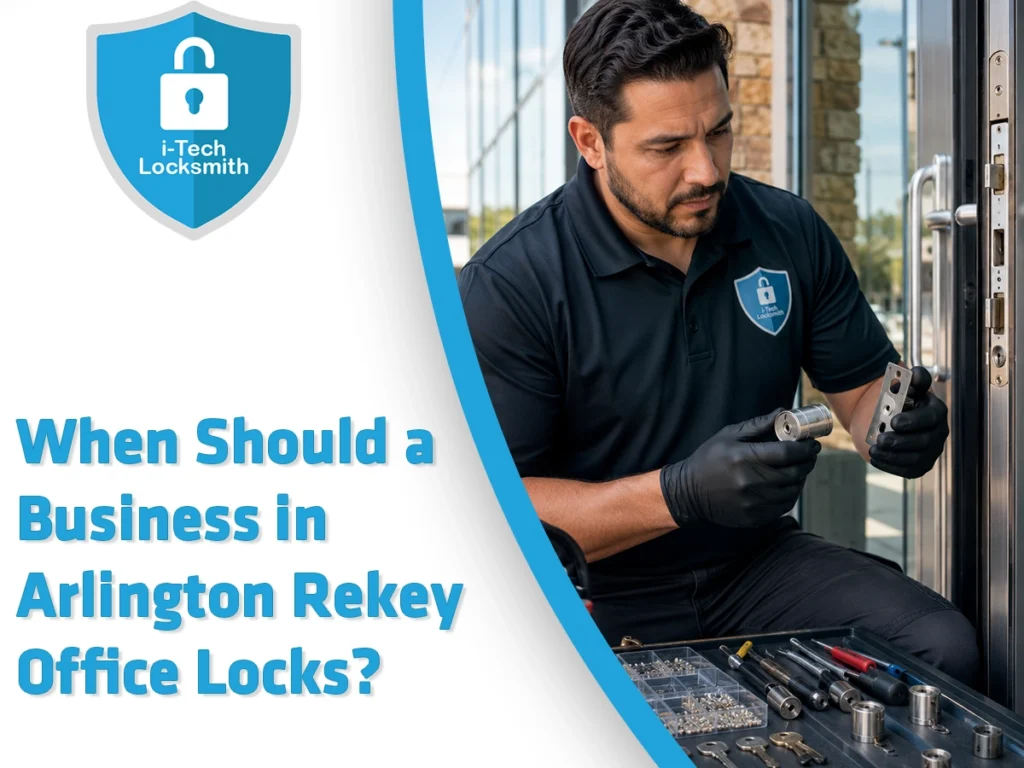
9 Critical Times to Rekey Office Locks in Arlington
One unreturned office key can keep several doors open to someone who no longer has permission to enter. Therefore, Arlington business owners should not wait for a confirmed break in before reviewing who can access their property. Rekeying can cancel old keys while allowing a business to keep lock hardware that remains safe and functional.
AI Overview
A business should rekey office locks in Arlington when a key is lost, stolen, copied, or not returned. Rekeying is also wise after an employee leaves, a tenant changes, a contractor finishes work, or a business moves into a new space. In addition, managers should review the locks after a break in, a management change, or any event that creates doubt about key control.
Rekeying changes the internal pins or components of a compatible lock. As a result, the old key stops working and a new key operates the lock. It often costs less than replacing every lock because the existing hardware stays in place.
However, rekeying is not always the right answer. A damaged, weak, outdated, or unsuitable lock may need full replacement. Therefore, an Arlington commercial locksmith should inspect the door, cylinder, latch, key system, and access needs before recommending the best option.
1. Rekey Office Locks After an Employee Leaves
Employee turnover is one of the most common reasons to rekey office locks in Arlington. Even when a worker returns a key, a manager cannot always confirm that no copy exists.
Most departing employees do not pose a threat. However, access decisions should rely on clear security rules rather than personal trust alone. A consistent policy also prevents managers from treating similar departures in different ways.
Rekeying may be important when:
- A former employee had keys to an exterior entrance
- A manager had access to storage, records, cash, or equipment
- A worker left without completing the normal exit process
- A key was not returned by the final workday
- Nobody knows how many copies were made
The risk becomes higher when one key opens several doors. For example, a supervisor may have access to the main entrance, supply rooms, offices, and loading areas.
A business should first list every door that the former worker could open. Then, the locksmith can identify which cylinders need new keys. This method limits unnecessary work while restoring control over important areas.
A clear departure checklist should also include:
- Collecting all physical keys
- Canceling access cards and door codes
- Recording which keys were returned
- Reviewing shared lockboxes
- Updating the list of approved key holders
CISA physical security guidance advises organizations to monitor workplace entry and keep an inventory of keys, cards, badges, and similar access items. Therefore, rekeying should be part of a larger access control process, not an isolated task. t When an Office Key Is Lost or Stolen
A lost office key creates uncertainty. The key may be under a desk, inside a vehicle, or in a public place. Unfortunately, the business cannot know who may find it.
A stolen key creates an even greater concern. In that case, someone may know which company, office, or property the key serves.
An Arlington business should consider immediate rekeying when:
- A key ring contains a company name or address
- The missing key opens an outside door
- The key provides access to private records
- The key opens rooms with cash or valuable equipment
- The key disappeared during a theft
- The loss involved a master key
First, document when and where the key was last seen. Next, identify every lock that accepts it. Then, restrict access to sensitive areas until the locks can be assessed.
Managers should not depend only on a sign in sheet or verbal warning. Those actions may help staff stay alert. However, they do not stop the missing key from operating the lock.
Rekeying changes the lock so the lost key no longer works. Therefore, it can remove the known access risk without replacing usable commercial hardware.
For a wider explanation of the service, review this guide to rekeying compared with replacing locks.
3. Rekey Every New Office Before Moving In
A business moving into a new Arlington office should not assume it received every existing key. Former tenants, cleaning crews, vendors, property workers, and contractors may still have copies.
Even when a landlord provides a new key, the company should ask whether the cylinder was rekeyed for the new tenancy. A newly cut copy of an old key does not create a new key combination.
Before moving equipment or records into the space, review:
- Main employee entrances
- Rear and side doors
- Delivery entrances
- Private offices
- File and record rooms
- Server and utility rooms
- Interior storage areas
The review should also include connecting suites. In some buildings, doors between units may use older hardware that receives less attention than the main entrance.
A locksmith can test whether several doors share one key. Then, the business can decide whether to keep that setup or create separate access levels.
Before rekeying a leased office, managers should also review the lease. Some landlords control changes to exterior locks or require copies of new keys. Therefore, written approval may be needed before the work begins.
However, the need for landlord approval should not stop the business from raising a valid security concern. The property manager and locksmith can often coordinate the work while protecting required building access.
4. Rekey After Contractors or Temporary Workers Leave
Temporary access often becomes permanent by accident. A contractor receives a key for a short project, but nobody records its return. Months later, managers may not remember who received it.
This issue can affect:
- Construction crews
- Cleaning companies
- Maintenance workers
- Technology vendors
- Delivery teams
- Seasonal employees
- Temporary office staff
Businesses should avoid giving a general master key when a limited key will meet the need. Instead, the person should receive access only to the doors required for the work.
A temporary access record should include:
- The name of the key holder
- The key number or label
- The doors the key opens
- The date the key was issued
- The expected return date
- The date it was returned
If a key is not returned, rekey the affected locks. In addition, review whether that key could open sensitive rooms beyond the work area.
For businesses with frequent temporary staffing, electronic access or a structured master key system may offer better control. However, the system must fit the building, budget, and daily workflow.
The older article about temporary access for holiday employees provides more ideas for managing short term access.
5. Respond After a Break In or Attempted Entry
A break in changes the security conditions of a property. Even when the intruder did not enter through a keyed lock, the event may expose weak doors, loose hardware, or poor access practices.
After an incident, protect the scene and contact law enforcement when appropriate. Do not repair or move damaged items before officers give permission.
Once the scene is released, inspect:
- Exterior lock cylinders
- Door frames
- Strike plates
- Hinges and closers
- Latches and deadbolts
- Rear service doors
- Interior restricted rooms
Rekeying may be appropriate when keys were taken or access control is uncertain. However, replacement may be safer when the lock was drilled, forced, bent, or damaged.
A rekey does not repair a cracked frame or weak strike plate. Likewise, a strong new cylinder cannot correct a door that does not close and latch correctly.
Therefore, the inspection should address the complete door assembly. It should not focus only on the key cylinder.
Businesses that use burglar alarms should also review Arlington requirements. The City of Arlington states that residences and businesses using alarms intended to summon police must maintain an alarm permit. Managers can review the current information through the City of Arlington alarm permit page. rity planning ideas, see these commercial security enhancements.
6. Rekey When Nobody Knows Who Has Copies
Poor key records create a quiet security problem. The doors may appear secure, yet managers cannot answer a basic question: Who can open them?
This often happens when:
- Keys were copied without approval
- Several managers issued keys over many years
- Keys have no clear labels
- Former workers still appear on the key list
- Vendors share keys between team members
- Master keys were distributed too widely
In this situation, collecting known keys does not solve the full problem. Unknown copies may remain outside the company.
A controlled rekey can create a clear starting point. After the new keys are issued, the business should record each key and require approval before making copies.
Good key control may include:
- Numbered keys
- Signed issue records
- Limited master key access
- Secure storage for spare keys
- Regular access reviews
- A written return process
The goal is not to create paperwork without purpose. Instead, each record should help the business know who has access, why they need it, and when that access ends.
CISA describes physical security planning as a scalable process for organizations of different sizes. Its resources also stress the value of facility access control and consistent security planning. Locks After a Management or Ownership Change
A new owner or manager inherits more than the office space. That person may also inherit years of keys, access habits, and undocumented permissions.
Therefore, leadership changes provide a good time to review:
- Who holds exterior keys
- Who has master keys
- Which vendors have access
- How spare keys are stored
- Which areas contain sensitive assets
- Whether the current system matches staff roles
Rekeying can help the new leadership team establish a clear access policy. However, it should not be used as a substitute for communication.
Employees should know:
- Why the keys are changing
- When old keys will stop working
- Where new keys will be issued
- Who can approve additional access
- How to report a missing key
A planned change usually causes less disruption than an urgent change. Therefore, schedule the work when managers can distribute keys and test each door.
The locksmith should also label new keys in a way that does not reveal the exact door to a stranger. For example, a coded number may be safer than writing the full office name on the key.
8. Rekey During a Security Policy Update
Some businesses wait for a lost key or employee departure before reviewing access. However, a planned security review can find problems before an incident occurs.
A business may review its locks:
- During an annual risk assessment
- After adding a new department
- After changing business hours
- Before storing higher value inventory
- After moving records into a new room
- When staff duties change
There is no single rekey schedule that fits every Arlington business. A small office with three controlled keys has different needs from a busy retail site with frequent staff changes.
Therefore, the rekey interval should depend on:
- Employee turnover
- Number of key holders
- Value of protected property
- Key copying controls
- Past security events
- Condition of the locks
- Business operating hours
A business with stable access and accurate records may not need frequent rekeying. However, a company with missing records and regular staff changes may need more reviews.
For additional context, read this guide about how often locks should be rekeyed.
9. Rekey When Access Levels No Longer Match Job Roles
Not every employee should open every door. Yet, access often expands over time and rarely gets reduced.
For example, a worker may receive a storage room key for one project. Later, the person changes roles but keeps the key.
Review access when:
- Employees move between departments
- Supervisors change responsibilities
- Inventory is moved
- Private records change location
- Cash handling duties change
- New restricted areas are created
A locksmith may be able to rekey groups of doors so different keys provide different access levels. This can reduce the number of keys that managers carry.
However, master key systems require careful planning. A poor design may give too much access or create confusion during future changes.
Before setting up a system, identify:
- Every controlled door
- Each employee role
- The access each role needs
- Which managers need broader access
- Who will control key duplication
The final plan should support daily work while limiting unnecessary entry. More access is not always more useful. In fact, excessive access can make accountability harder.
10. Understand What Rekeying Changes
Rekeying does not mean cutting another copy of the same key. Instead, the locksmith changes the lock so a different key operates it.
For many pin tumbler locks, the locksmith changes internal pins to match a new key. Other commercial cylinders may use different components or service methods.
A normal commercial rekey may include:
- Inspecting the existing lock
- Removing the cylinder when needed
- Changing internal components
- Cutting new keys
- Reinstalling the cylinder
- Testing the lock from both sides
- Confirming that the old key fails
The existing handles, levers, and much of the lock hardware may remain in place. Therefore, rekeying can be faster and less costly than replacing complete locksets.
However, not every lock can or should be rekeyed. Compatibility depends on the lock type, condition, keyway, design, and available parts.
A professional assessment should confirm:
- Whether the cylinder is serviceable
- Whether the door latches correctly
- Whether the hardware meets current needs
- Whether the key system provides enough control
- Whether replacement offers better long term value
11. Know When Replacement Is the Safer Choice
Rekeying restores key control. However, it does not make weak hardware stronger.
Replacement may be a better choice when:
- The lock is badly worn
- The cylinder moves inside the door
- The key regularly sticks
- The latch does not hold
- The hardware was forced
- Parts are missing
- The lock no longer fits the business risk
- The company wants electronic access
A locksmith should explain why replacement is recommended. In addition, the estimate should clearly separate required work from optional upgrades.
For example, a damaged exterior cylinder may require replacement. However, an undamaged interior office cylinder may only need rekeying.
This door by door approach can control costs while addressing the highest risks first.
Managers should also consider the age and quality of the complete opening. A new lock may still perform poorly when installed on a damaged door or weak frame.
12. Plan the Rekey Without Disrupting Operations
Rekeying several office doors requires coordination. Poor planning can leave employees waiting outside or using the wrong keys.
Before service begins:
- Create a complete door list
- Identify required access levels
- Count the needed keys
- Choose an authorized decision maker
- Notify affected staff
- Review landlord requirements
- Select a suitable service time
During the work:
- Keep old and new keys separate
- Test each completed door
- Record which key opens each area
- Confirm emergency exit functions
- Avoid blocking required exits
- Report damaged hardware
After the work:
- Issue keys directly to approved staff
- Collect old keys
- Update the access record
- Store spare keys securely
- Set a rule for future copies
- Schedule a security review
The business should also ensure that rekeying does not interfere with fire exit hardware or life safety functions. Commercial doors may have special requirements that differ from residential doors.
Therefore, the locksmith should understand commercial door hardware and know when another qualified door professional is needed.
13. Choose an Arlington Commercial Locksmith Carefully
The person servicing office locks may receive temporary access to sensitive parts of the property. Therefore, businesses should verify the provider before authorizing work.
Ask the locksmith to:
- Confirm the requested scope
- Explain whether rekeying is suitable
- Identify damaged hardware
- Provide clear pricing
- Protect the door and frame
- Test all completed locks
- Provide an itemized invoice
The business should also confirm who can authorize the service. A responsible locksmith may request identification and proof that the customer has the right to control the property.
Avoid providers who:
- Refuse to explain the work
- Push drilling before inspecting the lock
- Give unclear pricing
- Recommend replacing everything without a reason
- Cannot describe how the new keys will be controlled
- Leave completed doors untested
A professional locksmith should help the decision maker understand the tradeoffs. The goal is not simply to make a new key. The goal is to restore controlled access with the least unnecessary cost and disruption.
14. A Practical Arlington Office Rekey Scenario
Consider a small Arlington office with a main entrance, rear door, supply room, records room, and private management office.
A supervisor leaves the company. The supervisor returns one key, but the business has no record showing how many copies existed.
A reasonable process would be:
- List every door the supervisor could open
- Check whether the returned key is a master key
- Review the condition of each affected lock
- Rekey the needed cylinders
- Issue new keys only to approved staff
- Record each new key
- Test every affected door
The business may not need to rekey a conference room that the old key never opened. Likewise, it may not need to replace safe hardware that remains functional.
However, the company should not ignore the issue merely because the key was returned. The missing information is the real concern.
This is an example of a decision process, not a claim about a specific I-Tech Locksmith – Arlington customer.
15. Why Timely Rekeying Protects More Than Property
Office security is not only about computers, inventory, or furniture. It also affects employees, customers, records, and business continuity.
Timely rekeying can help:
- Restore control over entry
- Protect private work areas
- Reduce access uncertainty
- Support employee safety
- Improve key records
- Limit disruption after a key loss
However, locks are only one part of physical security. Businesses should also review lighting, alarms, visitor procedures, cameras, door condition, and staff reporting rules.
CISA provides physical security resources that organizations can use when building broader protective plans. connects each measure. For example, an alarm may report an entry, while a controlled lock helps prevent that entry.
Conclusion
A business should rekey office locks in Arlington whenever it can no longer confirm who has working keys. Common triggers include lost keys, employee departures, tenant changes, contractor access, ownership changes, security incidents, and weak key records.
Rekeying is often a practical choice when the current lock hardware remains safe and functional. It disables old keys without requiring complete replacement.
However, damaged or outdated locks may need new hardware. Therefore, the best decision begins with a complete inspection of the key system, lock, door, frame, latch, and access needs.
Most importantly, do not wait for a break in to reveal poor key control. A planned rekey can help an Arlington business restore access control before uncertainty becomes a larger security problem.
Frequently Asked Questions
Can commercial office locks be rekeyed instead of replaced?
Many commercial cylinders can be rekeyed when their hardware remains compatible and functional. The locksmith changes the internal key combination so old keys stop working. However, locks that are damaged, severely worn, obsolete, or unsuitable for the door may require replacement instead.
Should a business rekey locks after an employee leaves?
A business should consider rekeying when a departing employee had exterior, master, or sensitive area keys. The need becomes stronger when a key was not returned or the company cannot confirm whether copies exist. A consistent departure policy helps managers make fair and timely access decisions.
How soon should office locks be rekeyed after a key is lost?
Sensitive locks should be assessed as soon as the loss is discovered. Immediate action is especially important when the key is labeled, stolen, or connected to an exterior entrance, records room, equipment area, or master key system. Temporary controls may be needed until rekeying is complete.
Is it cheaper to rekey or replace commercial locks?
Rekeying often costs less because the existing lock hardware stays in place. However, the final cost depends on the lock type, number of cylinders, key system, hardware condition, and access plan. Replacement may offer better value when locks are damaged, weak, or outdated.
How often should an Arlington business rekey office locks?
There is no fixed schedule for every company. Businesses should base the timing on staff turnover, lost keys, access records, contractor use, property changes, and security risks. An annual key control review can help managers identify uncertainty before an urgent rekey becomes necessary.
Contact I-Tech Locksmith – Arlington
Protect your Arlington office by restoring control over every working key. I-Tech Locksmith – Arlington can inspect your commercial locks, explain whether rekeying or replacement is suitable, and help create a practical access plan.
Contact us at
Phone: 817-383-1387
Location: 1738 W Division St, Arlington, TX 76012
Website: www.i-tech-locksmith.com