
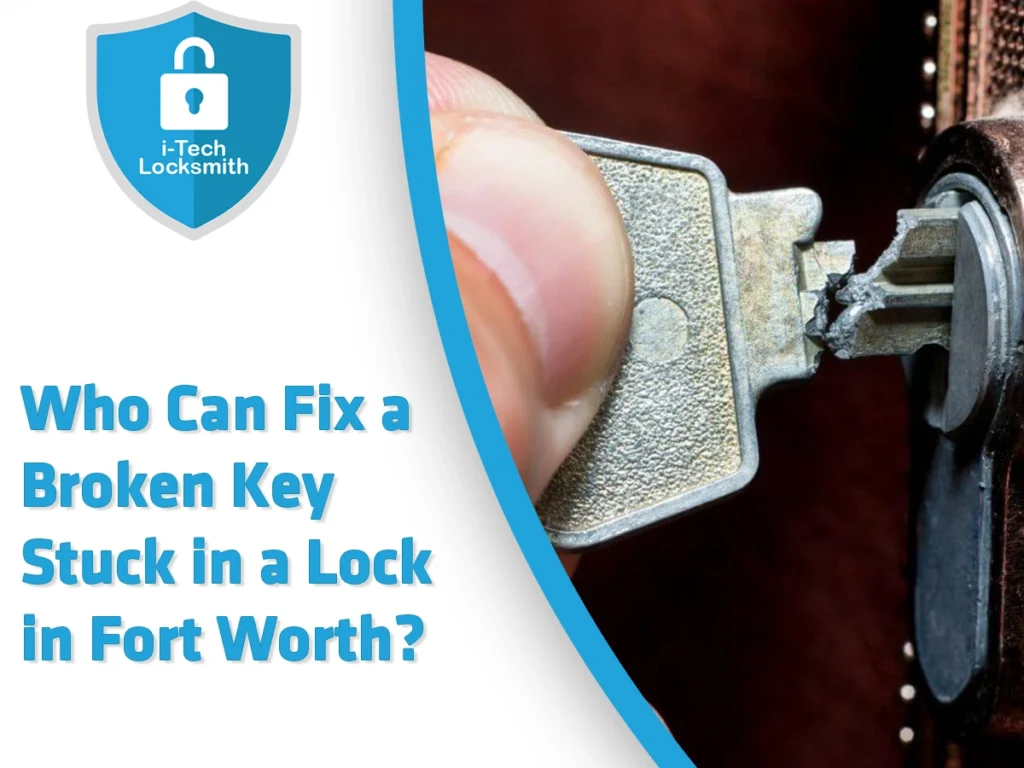
17 Powerful Steps for Safe Broken Key Removal
A key often breaks after the lock has already shown warning signs. Weather, poor door alignment, worn keys, and worn hardware can all make a lock difficult to operate before the key finally snaps.
AI Overview
A qualified locksmith can remove a broken key stuck in a lock in Fort Worth. The service may include extracting the fragment, inspecting the lock cylinder, correcting door alignment, cutting a replacement key, rekeying the lock, or replacing damaged hardware.
The correct method depends on how deeply the fragment sits, whether the key turned before breaking, and whether internal lock parts remain intact. A visible fragment may be easier to remove. However, a piece pushed deep into the keyway may require professional extraction tools or partial cylinder disassembly.
Do not use glue, drills, knives, or another key to force the fragment out. Those methods can push the broken piece deeper, damage internal pins, or make the cylinder harder to repair.
After extraction, the locksmith should identify why the key broke. A worn key may be the only problem. However, a jammed cylinder, poor door alignment, corrosion, or internal failure may also need attention.
ALOA lists key creation, rekeying, lock installation, and emergency service among the services professional locksmiths provide. Therefore, a locksmith can often address both the broken fragment and the problem that caused it.
1. Call a Locksmith When the Key Breaks Inside the Lock
A locksmith is usually the most suitable professional for a broken key inside a residential, automotive, or commercial lock.
A locksmith may be able to:
- Remove the broken fragment
- Inspect the cylinder
- Cut a replacement key
- Repair the lock
- Rekey the cylinder
- Replace damaged hardware
The technician should first determine:
- Where the fragment is located
- Whether part of the key remains visible
- Whether the cylinder was turned
- Whether the lock was already difficult
- Whether another working key exists
- Whether the door is open or locked
These details affect the extraction method.
For example, a fragment near the front of the keyway may be removed without disassembling the lock. Conversely, a fragment trapped behind internal components may require the cylinder to be removed.
A professional locksmith should also protect the surrounding door, vehicle trim, or commercial hardware during the service.
ALOA describes locksmiths as security professionals who install locks, create keys, rekey hardware, and respond to emergency calls.
2. Stop Turning the Key After It Starts to Bend
A key rarely becomes stronger after it begins bending. Instead, the weakened metal becomes more likely to snap during the next turn.
Stop using the key when:
- The blade looks bent
- A crack appears near the head
- The key twists during use
- The teeth show heavy wear
- The key works only at one angle
- Extra pressure is required
A worn key can damage the lock because its cuts may no longer move the internal components correctly.
Likewise, forcing the key can:
- Break the blade
- Bend internal parts
- Damage the keyway
- Trap the fragment deeper
- Increase extraction difficulty
- Create a complete lockout
Use another known good key when one is available. However, stop immediately if the second key also meets strong resistance.
When several keys struggle in the same lock, the lock or door is more likely to be part of the problem.
ALOA identifies worn keys, lock wear, weather, and poor door alignment as common causes of difficult operation.
3. Do Not Push the Fragment Deeper
The position of the broken fragment can determine whether the extraction remains simple.
Avoid inserting:
- Another key
- A knife
- A screwdriver
- A drill bit
- A thick wire
- An oversized pick
These objects may move the fragment beyond the front of the keyway. In addition, they may bend internal pins or block the narrow space needed for an extractor.
Do not repeatedly press the remaining key piece against the fragment. The broken surfaces may not reconnect firmly enough to pull the blade out.
Instead:
- Stop using the lock
- Keep the remaining key piece
- Photograph the keyway when useful
- Tell the locksmith how the key broke
- Avoid changing the cylinder position
- Protect the opening from dirt
The remaining part of the key can help the technician understand its shape and wear. It may also help when cutting a replacement.
For more information about risky removal attempts, review this guide about extracting broken keys without causing more damage.
4. Never Use Household Glue on the Key
Online advice sometimes recommends placing glue on the broken key head and pressing it against the trapped fragment.
This method can create several new problems.
Glue may:
- Enter the keyway
- Bond to internal pins
- Harden around the fragment
- Prevent normal cylinder movement
- Damage the finish
- Make professional extraction harder
The two broken surfaces are also small and uneven. Therefore, the bond may fail before the fragment moves.
Even worse, the glue may remain inside the lock after the key head separates again.
A locksmith may then need to:
- Remove the cylinder
- Clean internal parts
- Replace damaged components
- Rekey the lock
- Install a new cylinder
- Replace the complete lock
The safest approach is to keep adhesives away from security hardware.
5. Tell the Locksmith Whether the Key Turned
The cylinder position matters during extraction.
If the key broke before turning, the keyway may remain in its normal removal position. That condition may provide a clearer path for the fragment.
However, if the key broke after the cylinder turned, internal components may hold the fragment in place.
Tell the technician:
- Whether the key moved
- Which direction it moved
- Whether the bolt extended
- Whether the door opened
- Whether the cylinder returned
- Whether the fragment can move
Do not force the cylinder back with another tool.
The technician may need to:
- Stabilize the cylinder
- Return it carefully
- Remove the lock
- Access the back of the cylinder
- Extract the fragment
- Inspect internal components
Accurate information helps the locksmith prepare the correct tools and avoid unnecessary damage.
6. Keep the Broken Part of the Key
Do not throw away the part that remains in your hand.
The broken key can reveal:
- Where the metal failed
- Whether the blade was bent
- How worn the cuts are
- Whether the key was duplicated poorly
- The key profile
- Possible corrosion
The remaining piece may also help the locksmith create a replacement.
However, a badly worn key should not always serve as the only pattern. Copying wear onto a new blank can create another key that operates poorly.
The locksmith may instead use:
- A better spare key
- The lock code
- The cylinder
- Decoding equipment
- Manufacturer information
- A corrected key pattern
After cutting the replacement, the technician should test it several times without force.
7. Broken House Keys Need a Full Door Inspection
A residential key may break because the door has moved rather than because the cylinder has failed.
The technician should test:
- The lock with the door open
- The lock with the door closed
- The deadbolt movement
- The latch position
- The strike plate
- The hinges
If the lock works while the door is open but binds after closing, alignment may be the main cause.
Possible alignment problems include:
- Loose hinge screws
- A sagging door
- Frame movement
- A shifted strike plate
- Door swelling
- Weather related movement
Replacing only the key may not solve these conditions.
Instead, the locksmith may recommend:
- Adjusting the strike
- Tightening hardware
- Correcting minor alignment
- Servicing the bolt
- Repairing the lock
- Replacing damaged parts
ALOA notes that humidity, temperature, door alignment, worn hardware, and worn keys can all affect lock performance.
8. Broken Car Keys Need Automotive Tools
A broken automotive key can become trapped inside a door lock, trunk lock, or ignition cylinder.
Automotive extraction may require different methods because vehicle locks can contain:
- Small wafers
- Electronic components
- Steering lock parts
- Immobilizer systems
- Delicate trim
- Security sensors
Do not use pliers when only a tiny part of the key is visible. Pliers may damage the ignition face or push the fragment deeper.
Tell the automotive locksmith:
- Vehicle make
- Vehicle model
- Model year
- Key type
- Fragment location
- Whether another key exists
The technician may also ask for:
- Vehicle identification number
- Government identification
- Registration
- Proof of insurance
- Fleet authorization
- Rental documents
After removal, a replacement automotive key may need both cutting and electronic programming.
ALOA explains that modern automotive locksmith work can involve keys, fobs, access features, and vehicle security systems.
9. Ignition Key Extraction Requires Careful Diagnosis
A key broken in an ignition may involve more than a weak blade.
Possible causes include:
- A worn key
- A worn ignition cylinder
- Steering lock pressure
- Internal wafer damage
- Dirt inside the cylinder
- Excessive turning force
Before extraction, the technician should ask:
- Was the steering wheel locked?
- Was the vehicle in the correct gear?
- Did the key turn partway?
- Was the ignition already sticking?
- Does another key exist?
- Has the cylinder been repaired before?
After extraction, the ignition should be tested carefully.
A replacement key should not be forced into a cylinder that still binds. Otherwise, the new key may become damaged as well.
Some ignition problems may require an automotive locksmith. Others may involve vehicle electrical or mechanical systems that need a qualified repair facility.
10. Commercial Broken Keys Can Interrupt Operations
A broken key at a business can delay opening, block a restricted room, or prevent a door from being secured.
Commercial extraction may involve:
- Storefront cylinders
- Office locks
- Mortise cylinders
- Interchangeable cores
- Storage rooms
- Utility areas
Before service, the locksmith should verify that the requester has authority to control the door.
Verification may include:
- Business identification
- Management approval
- Lease information
- Property management confirmation
- Government identification
- Company authorization
After removing the key, the technician should inspect the complete opening.
This may include:
- Cylinder condition
- Lock body
- Door alignment
- Strike plate
- Exit hardware
- Key control
Workplace exits need special care. OSHA requires exit routes to remain free and unobstructed, while exit doors must support safe egress from occupied areas.
Therefore, improvised locks or temporary devices should never block a required exit.
11. Extraction Does Not Always Mean the Lock Is Repaired
Removing the fragment solves one visible problem. However, it may not correct the cause.
After extraction, the locksmith should check for:
- Bent internal components
- Worn pins or wafers
- Metal debris
- Keyway damage
- Cylinder movement
- Bolt resistance
The lock should then be tested:
- With the door open
- With the door closed
- From the outside
- From the inside
- With every new key
- Through repeated cycles
BHMA standards for cylinders include operational, strength, security, material, finish, and dimensional testing requirements. These standards show why reliable lock performance involves more than whether one key turns once.
A lock that still binds, moves, or fails to latch may need additional service.
12. Know When a New Key Is Enough
The lock may remain usable after extraction when:
- The fragment comes out cleanly
- Internal components remain intact
- The cylinder turns smoothly
- The bolt operates fully
- Door alignment is correct
- No structural damage is present
In that situation, the locksmith may cut a replacement key.
The new key should be checked for:
- Correct blank
- Accurate cuts
- Smooth insertion
- Smooth removal
- Reliable turning
- Proper bolt movement
The technician should avoid copying severe wear from the old key when a better method is available.
A spare key should also be considered. Having a tested backup can reduce the chance of another urgent lockout.
13. Know When the Lock Should Be Rekeyed
Rekeying changes the internal key combination while compatible hardware remains installed.
Rekeying may be appropriate when:
- The broken key was also lost earlier
- Unknown copies may exist
- A tenant or employee left
- Key control is uncertain
- The cylinder remains safe
- The owner wants new keys
However, rekeying does not repair structural damage.
The locksmith should not recommend rekeying as the only solution when:
- The cylinder is cracked
- Internal parts are broken
- The housing is loose
- Severe corrosion exists
- The lock repeatedly jams
- The hardware no longer secures the door
For a detailed comparison, read this guide to rekeying versus replacing locks.
14. Replace the Lock When Damage Is Severe
Replacement may be the safer option when the extraction reveals serious wear or damage.
Warning signs include:
- A cracked cylinder
- A bent bolt
- Missing internal parts
- Severe rust
- A loose lock body
- Repeated mechanical failure
Replacement may also be appropriate when:
- Parts are unavailable
- The keyway is badly damaged
- The hardware is outdated
- The lock was forced
- Repairs have already failed
- Security needs have changed
The locksmith should explain why replacement is needed and show the damage when possible.
Ask:
- Which part failed?
- Can it be repaired?
- Why is replacement safer?
- Which new lock is recommended?
- Will the door need adjustment?
- How many keys are included?
BHMA publishes performance standards for locks, latches, cylinders, and other builders hardware. Therefore, customers can ask about the function and grade of proposed replacement products.
15. Avoid Unnecessary Drilling
A broken key does not automatically require drilling the lock.
Drilling may become necessary when:
- Internal components have seized
- The cylinder cannot be removed normally
- Prior damage blocks extraction
- The lock has failed completely
- The keyway is severely damaged
- Another safe method is unavailable
However, the technician should inspect the lock before choosing that method.
Ask:
- Why is drilling required?
- Can the cylinder be removed another way?
- Which component will be destroyed?
- What replacement is needed?
- What will the total cost become?
- Will the door remain protected?
A professional locksmith should connect the proposed method to the actual condition.
ALOA warns consumers to be cautious about poor locksmith work that causes needless damage to doors, locks, homes, or vehicles.
16. Request Clear Pricing Before Extraction
Broken key extraction prices can vary because every lock and fragment position is different.
The total may depend on:
- Service location
- Time of the call
- Lock type
- Fragment depth
- Cylinder position
- Required disassembly
- Replacement key needs
- Lock damage
Ask whether the estimate includes:
- Service call
- Extraction labor
- Lock disassembly
- Replacement key
- Rekeying
- New hardware
- Taxes
- After hours charges
The dispatcher may provide a range before inspection. However, the technician should give a clearer estimate after seeing the lock.
Do not approve added work until the technician explains:
- What new damage was found
- Why another service is needed
- Which part will be installed
- What the added work costs
- Whether the original lock can remain
- What result to expect
The FTC recommends reviewing written estimates and agreements before repair work begins. It also cautions consumers against cash or wire transfer demands in repair scams.
17. Protect Yourself From Locksmith Scams
A broken key can create pressure because the customer may be locked outside or unable to secure the property.
Before dispatch, confirm:
- Company name
- Service area
- Pricing process
- Technician identification
- Payment methods
- Invoice policy
At arrival, verify:
- The technician’s name
- The company relationship
- The requested service
- The written estimate
- The extraction method
- Any replacement hardware
Warning signs include:
- An unrealistically low starting quote
- Refusal to name the company
- Immediate drilling without inspection
- Unexplained price increases
- Pressure to pay before work
- No written invoice
The FTC warns that scammers often create urgency and request difficult to reverse payments, including wire transfers, payment applications, cryptocurrency, or gift cards.
For more guidance, review this article about how to recognize locksmith scams.
18. Prevent Another Key From Breaking
A replacement key should not be the final step when the lock still has an underlying problem.
Preventive steps include:
- Replace worn keys early
- Stop forcing stiff locks
- Test locks with the door open
- Correct door alignment
- Protect exterior hardware
- Schedule service after repeated sticking
Also check:
- Hinge screws
- Strike plate position
- Cylinder movement
- Bolt travel
- Key condition
- Weather exposure
Fort Worth heat, rain, humidity, and changing weather can affect doors and exterior hardware. ALOA notes that humidity and temperature changes may affect door and lock performance.
This guide to weatherproofing locks provides additional prevention ideas.
19. Use a Simple Broken Key Checklist
Before calling:
- Stop turning the lock
- Keep the broken key head
- Avoid glue and drills
- Note whether the key turned
- Check whether another entrance is available
- Gather proof of access rights
During the call:
- Describe the lock type
- Explain the fragment position
- Mention existing lock problems
- Request a price range
- Confirm technician availability
- Ask about replacement key service
At arrival:
- Verify the company
- Review the estimate
- Confirm the method
- Approve additional work
- Request removed parts
- Keep the invoice
After service:
- Test the lock repeatedly
- Test the door closed
- Check every new key
- Confirm the bolt extends
- Review the final price
- Store a working spare
20. A Practical Fort Worth Broken Key Example
Consider a hypothetical Fort Worth homeowner whose key breaks in the front door.
Before breaking, the key required extra force every evening. The lock worked smoothly while the door was open but became difficult after closing.
A careful service process would include:
- Removing the fragment
- Inspecting the key wear
- Testing the cylinder
- Checking the door alignment
- Reviewing the strike position
- Cutting a replacement key
In this example, alignment may be the main cause. Adjusting the opening could prevent the new key from breaking.
Now consider another situation where:
- The cylinder is loose
- The fragment is twisted
- Internal parts are damaged
- The lock binds while open
- The bolt does not extend
- The housing is cracked
That condition may require cylinder or lock replacement after extraction.
These examples show decision methods. They do not describe verified I-Tech Locksmith – Fort Worth customers.
Frequently Asked Questions
Can a locksmith remove a broken key without replacing the lock?
A locksmith can often remove a fragment while preserving the lock. However, the result depends on the key position, cylinder condition, and internal damage. After extraction, the locksmith should test the cylinder, bolt, door alignment, and new key before confirming that replacement is unnecessary.
Should I use glue to remove a broken key?
No. Glue can enter the keyway, bond to internal components, and harden around the fragment. That damage may turn a simple extraction into cylinder repair or replacement. Stop using the lock, keep the broken key head, and contact a qualified locksmith instead.
Why did my key break inside the lock?
Common causes include key wear, bending, corrosion, poor duplication, lock wear, door alignment problems, and excessive force. The locksmith should inspect both the key and lock after extraction. Otherwise, a newly cut replacement may face the same resistance and break again.
Can a locksmith make another key after removing the fragment?
A locksmith may be able to cut a replacement from a good spare, the lock code, the cylinder, or the broken key information. A badly worn key should not always be copied directly because the wear may transfer poor operation to the new key.
Does a broken key mean I need a new lock?
Not always. A new key may be enough when the fragment is removed cleanly and the cylinder remains safe. Replacement becomes more likely when the cylinder is cracked, loose, corroded, internally damaged, repeatedly jammed, or unable to secure the door reliably.
Conclusion
A qualified locksmith can fix a broken key stuck in a lock in Fort Worth. The technician can remove the fragment, inspect the cylinder, cut a replacement key, and determine whether the lock needs repair, rekeying, or replacement.
Stop using the lock as soon as the key bends, cracks, or requires unusual force. Continued pressure can break the blade and push the fragment deeper.
Do not use glue, drills, knives, or another key. These methods can damage internal components and make professional extraction more difficult.
Tell the locksmith whether the key turned before breaking. Also explain whether the lock was already sticking, whether another key exists, and whether the door is open or locked.
After extraction, the technician should test the complete opening. The cylinder, bolt, strike plate, door alignment, hinges, and replacement key may all affect future performance.
A new key may be enough when the lock remains safe and smooth. Rekeying may be useful when key control has changed. However, severe wear, corrosion, cracks, or internal damage may require replacement.
Before approving service, verify the company, request clear pricing, and review the proposed method. Drilling should have a specific reason rather than being the automatic first choice.
Finally, test the completed lock several times while the door is open and closed. Keep a tested spare key and arrange service early when another lock begins showing the same warning signs.
Contact I-Tech Locksmith – Fort Worth
I-Tech Locksmith – Fort Worth can inspect a broken key stuck inside a residential, automotive, or commercial lock and explain the safest available service option.
The technician can assess the fragment, cylinder, keyway, door alignment, and surrounding hardware before recommending extraction, replacement key cutting, repair, rekeying, or new lock installation.
Contact us at
Phone: 817-663-0642
Location: 8520 Tamar Trail, Fort Worth, TX 76118
Website: www.i-tech-locksmith.com