18 Powerful Checks That Protect Your Property and Money
A low locksmith quote can become far more expensive after the technician arrives. ALOA warns that dishonest operators may advertise prices that appear unusually low, then increase the charge after gaining the customer’s commitment.
AI Overview
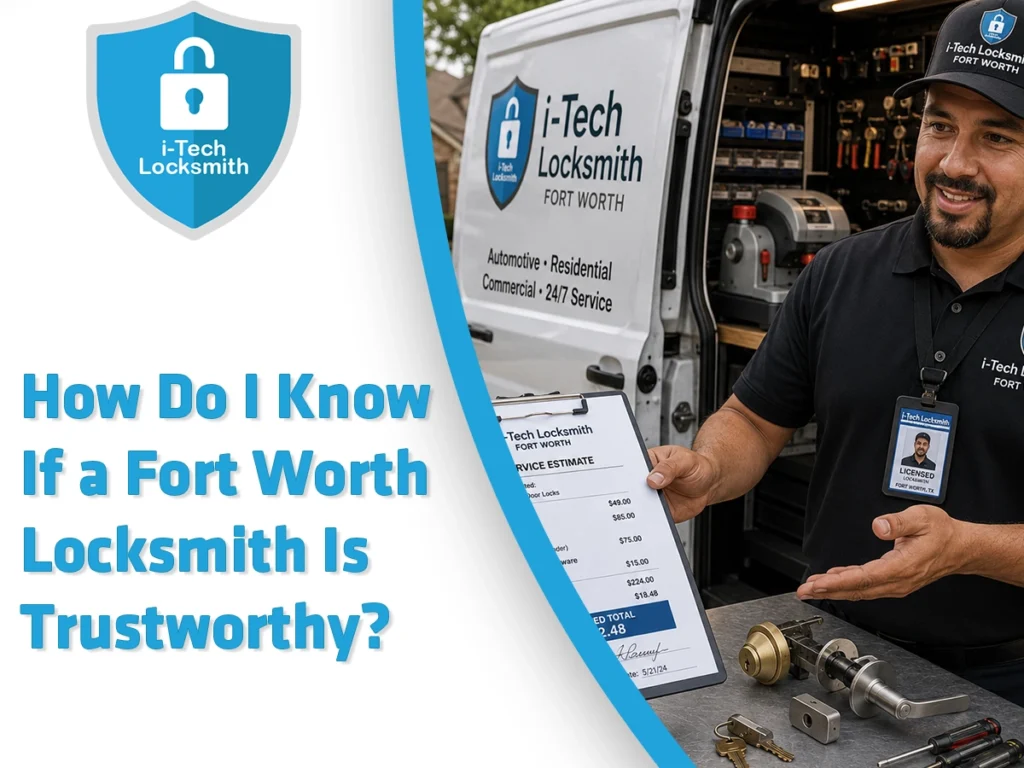
A trustworthy Fort Worth locksmith should provide a clear company name, verifiable Texas licensing information, technician identification, and a written estimate before approved work begins.
The locksmith should ask questions about the lock, door, vehicle, property, and reason for service. In addition, the technician should verify that the customer has authority to enter or change the locks.
A responsible locksmith normally inspects the problem before recommending drilling or complete replacement. The technician should explain the available options, expected result, parts, labor, and possible changes in price.
Customers should also review the company’s website, business information, public reviews, payment methods, and invoice process. However, no single review, logo, or advertisement proves that a provider is trustworthy. Several consistent signs create stronger evidence.
Texas includes locksmiths within the private security profession regulated by the Department of Public Safety. DPS provides licensing and registration resources, including access to its Texas Online Private Security system.
1. Verify the Full Locksmith Company Name
A trustworthy provider should clearly state the company name before dispatch.
Ask the person answering the phone:
- What is the complete company name?
- Will your employee perform the service?
- Are you sending a subcontractor?
- What company name will appear on the invoice?
- Who will receive the payment?
- Who handles warranty questions?
Write down the answer. Then, compare it with the name shown on the website, technician identification, estimate, invoice, and payment receipt.
A different name does not always prove fraud. Some businesses operate under registered trade names or use approved subcontractors. However, the relationship should be explained clearly before work begins.
Be cautious when the dispatcher answers with a generic phrase such as locksmith service and refuses to identify the business.
ALOA warns that some dishonest networks use assumed names, misleading local addresses, and subcontracted workers who may not represent the company shown in the advertisement.
2. Check Texas Licensing and Registration
Texas regulates locksmiths as part of the private security profession. Therefore, customers should ask whether the locksmith company and technician operate under current Texas requirements.
The Texas Department of Public Safety states that it regulates locksmiths under Chapter 1702 of the Texas Occupations Code and related administrative rules.
Ask the company:
- What name appears on the company license?
- Can you provide the license information?
- Is the arriving technician affiliated with that company?
- Can the information be verified through Texas DPS?
- Will the licensed company appear on the invoice?
- Who is responsible for the completed work?
Texas DPS identifies locksmith as an individual license type. Its guidance also states that individuals generally must be licensed and affiliated with a company or entity licensed by the department.
Licensing alone does not guarantee perfect service. However, it creates a basic verification point and a regulatory connection.
3. Confirm the Business Information Is Consistent
A trustworthy Fort Worth locksmith should provide business information that remains reasonably consistent across public sources.
Compare:
- Website company name
- Published phone number
- Service area
- Business address when listed
- Invoice information
- Payment recipient
Look for clear descriptions of:
- Residential services
- Automotive services
- Commercial services
- Emergency availability
- Pricing process
- Customer verification
Be cautious when a listing claims a Fort Worth location, yet the dispatcher cannot describe the area or explain who will perform the service.
A mobile locksmith does not need a public storefront to provide legitimate service. However, the company should not use misleading addresses or pretend to operate a local shop that does not exist.
The goal is consistency, not a specific business model.
4. Expect Detailed Questions During the Call
A professional dispatcher should ask enough questions to understand the service request.
For a house lockout, useful questions include:
- Is the key lost or locked inside?
- Is the door locked or only closed?
- What type of lock is installed?
- Is the lock damaged?
- Is another approved entrance available?
- Can you show proof of occupancy?
For a vehicle call, the company may ask:
- Vehicle make
- Vehicle model
- Model year
- Key type
- Vehicle location
- Whether every key is lost
For a business, the company may ask:
- Which entrance is affected?
- Who is authorizing the work?
- Is property management involved?
- Does the door use commercial hardware?
- Is the opening a required exit?
- Are several locks involved?
A provider that asks no questions may be preparing to use one aggressive method for every situation.
5. Request a Clear Estimate Before Dispatch
A trustworthy locksmith should explain the pricing process before sending a technician.
The company may not know the exact final cost without inspecting the lock. However, it should identify the likely charges and conditions that could change the price.
Ask whether the estimate includes:
- Service call
- Travel
- Labor
- After hours charges
- Drilling
- Replacement parts
Also ask:
- Is this a total or starting price?
- What could increase the amount?
- Does a service fee apply if I decline?
- Are taxes included?
- Which payment methods are accepted?
- Will I receive a written estimate onsite?
The FTC advises consumers to obtain written estimates, verify licenses and insurance, and review agreements before repair work begins.
An unusually low quote should receive extra scrutiny. It may cover only the arrival fee rather than the full service.
6. Review a Written Estimate Before Work
After inspection, the technician should provide a written estimate or another clear written record of the proposed work.
The estimate should identify:
- Company name
- Customer or service location
- Requested service
- Labor
- Parts
- Expected total
It should also explain:
- Whether drilling is planned
- Which lock may be replaced
- How many keys are included
- Whether after hours fees apply
- Which taxes or fees apply
- What could change the total
Do not sign a blank document.
Likewise, do not approve an estimate that lists only locksmith work without explaining the service.
When the technician finds hidden damage, the price may change. However, the locksmith should stop, explain the new problem, revise the estimate, and receive approval before continuing.
7. Confirm the Technician’s Identity
The arriving technician should be able to identify themselves and explain their relationship with the company you called.
Before allowing work, confirm:
- Technician name
- Company identification
- Company affiliation
- Service request
- Expected pricing
- Payment recipient
A marked vehicle or uniform can support identification, but neither one proves trustworthiness by itself.
Likewise, an unmarked vehicle does not automatically mean the provider is dishonest. Many small mobile businesses use standard vehicles.
The stronger signs are:
- Clear identification
- Consistent company information
- Verifiable licensing
- A written estimate
- Professional communication
- An itemized invoice
When the arriving technician names a different company, ask for an explanation before approving the work.
8. Expect Proof of Ownership or Authority
A trustworthy locksmith should verify that the person requesting entry or lock changes has authority over the property.
Depending on the situation, acceptable proof may include:
- Government identification
- Vehicle registration
- Lease information
- Property ownership records
- Business identification
- Property manager approval
If the documents are locked inside, explain that during the call. The technician may review them after entry.
For a company vehicle or commercial property, authorization may come from:
- Business owner
- Fleet manager
- Approved supervisor
- Landlord
- Property manager
- Leasing company
A locksmith willing to open any property without checking authorization creates a serious security concern.
9. Be Cautious About Immediate Drilling
Drilling may be necessary when a lock is damaged, internally failed, or resistant to reasonable entry methods.
However, it should not be the automatic first response to every lockout.
Before approving drilling, ask:
- Why is drilling needed?
- Which other methods were considered?
- Which part will be destroyed?
- Will replacement be required?
- What hardware will be installed?
- What is the revised total?
A professional should inspect:
- Cylinder
- Keyway
- Latch
- Deadbolt
- Door alignment
- Existing damage
ALOA warns that dishonest operators may perform poor work that damages locks, doors, homes, and vehicles. It also identifies low bait prices followed by inflated charges as a common pattern.
Drilling should be based on the actual condition, not the technician’s desire to sell a replacement lock.
10. Ask Why Lock Replacement Is Needed
A trustworthy locksmith should explain whether the existing hardware can be repaired, rekeyed, or retained.
Replacement may be appropriate when:
- The cylinder is cracked
- Internal parts have failed
- Forced entry caused damage
- Severe corrosion is present
- The hardware is unreliable
- Replacement parts are unavailable
Rekeying may be enough when:
- A key was lost
- A tenant moved
- An employee left
- Unknown copies may exist
- The hardware remains safe
- New key control is needed
Repair may be appropriate when:
- A fastener is loose
- Door alignment caused binding
- A replaceable component failed
- The cylinder needs approved service
- The latch needs adjustment
- The key is worn
Review this guide to rekeying versus replacing locks before approving unnecessary replacement.
11. Examine the Technician’s Work Process
Trustworthy service involves more than arriving quickly.
A careful locksmith should:
- Inspect before drilling
- Protect nearby surfaces
- Use suitable tools
- Explain the method
- Request approval
- Test the completed work
The technician should not:
- Force the key without diagnosis
- Damage the door unnecessarily
- Install unknown parts without approval
- Leave the lock untested
- Ignore the frame or strike
- Leave debris behind
ALOA describes professional locksmiths as security specialists who may provide recommendations involving locks, doors, frames, access control, and life safety concerns.
This broader approach matters because a new cylinder cannot correct a cracked frame or badly aligned door.
12. Review the Replacement Hardware
When replacement is required, ask what product will be installed.
The technician should explain:
- Brand
- Lock type
- Function
- Number of keys
- Product grade when relevant
- Warranty
Ask whether the hardware is:
- New
- Compatible with the door
- Suitable for the traffic level
- Appropriate for exterior use
- Compatible with existing keys
- Part of an optional upgrade
Do not accept vague claims such as this is the best lock without an explanation.
A trustworthy locksmith should connect the product features to the property’s actual needs.
For example, a commercial entrance may require different hardware from a low use interior office. Likewise, a residential deadbolt may not suit a narrow storefront door.
13. Check Reviews Without Trusting Them Alone
Online reviews can help identify patterns, but they should not be the only deciding factor.
Look for reviews that describe:
- Pricing
- Identification
- Service method
- Work quality
- Invoice accuracy
- Problem resolution
Be cautious when reviews:
- Use nearly identical wording
- Appear in large groups
- Provide no service details
- Mention unrelated work
- Focus only on arrival speed
- Never discuss pricing
Also examine negative reviews.
A few complaints do not automatically prove that a company is unreliable. However, repeated complaints about the same pricing or damage issue deserve attention.
Pay attention to how the business responds. A professional response should address concerns without threats, insults, or disclosure of unnecessary customer information.
14. Ask About Insurance and Warranty Coverage
The FTC recommends checking licenses and insurance before approving repair work.
Ask the locksmith company:
- Do you carry appropriate business insurance?
- Is accidental property damage covered?
- Is labor covered by a warranty?
- Are installed parts covered?
- Who handles warranty requests?
- Will warranty terms appear in writing?
The answer may depend on the service.
A simple vehicle entry may have different warranty terms from a new commercial lock installation.
However, the company should clearly explain:
- What is covered
- How long coverage lasts
- What voids coverage
- Who must be contacted
- Whether proof of payment is required
- Whether parts have separate warranties
Keep the invoice because warranty service may require it.
15. Review Payment Terms Before Work
A trustworthy provider should explain accepted payment methods before the technician begins.
Possible methods may include:
- Credit card
- Debit card
- Cash
- Business check
- Approved digital payment
- Commercial account billing
Be cautious when the technician demands:
- Gift cards
- Cryptocurrency
- Wire transfer
- Payment to an unrelated person
- Full payment before inspection
- Cash without a receipt
The FTC advises consumers not to pay repair providers through cash or wire transfer when those methods remove useful protections and records.
Before paying, verify:
- The amount matches the estimate
- Additional work was approved
- Parts are listed
- The company name is correct
- Taxes and fees are clear
- A receipt will be provided
16. Expect an Itemized Invoice
The final invoice should describe what was completed.
It may include:
- Service call
- Entry labor
- Rekeying
- Lock repair
- Replacement parts
- New keys
For automotive work, it may also include:
- Vehicle entry
- Key cutting
- Transponder programming
- Fob replacement
- Broken key extraction
- Ignition service
For commercial work, it may list:
- Number of cylinders
- Master key changes
- Door hardware
- Access control components
- Labor by opening
- Approved additional work
Compare the invoice with the estimate.
Ask for an explanation when the invoice includes unknown parts, duplicate fees, or labor that was never approved.
17. Watch for Pressure or Threats
A trustworthy locksmith should allow the customer to review the estimate and ask reasonable questions.
Be cautious when the technician:
- Refuses to explain charges
- Begins without approval
- Blocks you from calling someone
- Threatens to damage the property
- Demands immediate payment
- Becomes aggressive when questioned
You may decline unapproved work.
However, a disclosed service call fee may still apply when the technician has already traveled to the location.
When you feel unsafe:
- Move to a secure area
- Call someone you trust
- Avoid physical confrontation
- Document the situation
- Contact police during a threat
- Preserve all messages
Urgency does not remove your right to understand the service.
18. Prepare Before You Need Emergency Service
The best time to evaluate a locksmith is before a lockout happens.
Research a Fort Worth provider and save:
- Company name
- Website
- Phone number
- Licensing details
- Service area
- Business hours
Also prepare:
- Trusted spare key
- Roadside assistance information
- Property manager contact
- Vehicle registration
- Business authorization process
- Emergency contact
For homes:
- Replace worn keys
- Repair sticking locks early
- Test spare keys
- Maintain smart lock batteries
- Review access after moving
- Avoid obvious key hiding places
For vehicles:
- Make a programmed spare
- Replace weak fob batteries
- Store registration safely
- Use manufacturer access options
- Repair damaged keys
- Keep roadside details available
For businesses:
- Track issued keys
- Limit master keys
- collect keys after staff changes
- Maintain approved vendor contacts
- Test exterior entrances
- Document emergency authority
19. Use a Trustworthy Locksmith Checklist
Before dispatch, confirm:
- Full company name
- Texas licensing information
- Service call charge
- Expected price range
- Payment methods
- Technician identification process
At arrival, confirm:
- Technician identity
- Company affiliation
- Proof of authority requirements
- Inspection findings
- Proposed method
- Written estimate
Before work, confirm:
- Labor
- Parts
- Drilling
- Replacement hardware
- Total price
- Warranty terms
After service, confirm:
- Lock operation
- Door alignment
- New key testing
- Itemized invoice
- Receipt
- Removed hardware when requested
This process does not guarantee perfection. However, it gives the customer several opportunities to identify inconsistencies before losing control of the service.
20. A Practical Fort Worth Trust Example
Consider a hypothetical Fort Worth homeowner who calls after a key breaks in the front door.
The dispatcher:
- States the full company name
- Asks about the lock
- Explains the service call
- Gives a reasonable price range
- Describes required identification
- Confirms accepted payment methods
After arrival, the technician:
- Shows identification
- Verifies occupancy
- Inspects the fragment
- Explains the extraction method
- Provides a written estimate
- Requests approval
After extraction, the technician tests the cylinder and finds that the door alignment caused excessive resistance.
The customer receives a revised option for adjustment rather than an unnecessary full replacement.
This process demonstrates several trust signals.
Now consider another provider that:
- Refuses to identify the company
- Gives only a very low starting price
- Asks no questions
- Immediately recommends drilling
- Will not provide a written total
- Demands cash
That process contains several warning signs.
These examples describe evaluation methods. They do not represent verified I-Tech Locksmith – Fort Worth customer cases.
Frequently Asked Questions
How can I verify a Fort Worth locksmith’s license?
Ask for the complete company name and available Texas licensing information. Texas regulates locksmiths through the Department of Public Safety Private Security Program. You can review licensing resources through Texas DPS and its Texas Online Private Security system before approving non emergency work.
Should a locksmith give me a written estimate?
A trustworthy locksmith should explain expected charges during dispatch and provide a clearer written estimate after inspecting the problem. The estimate should identify labor, service fees, parts, possible drilling, taxes, and the total. Price changes should require explanation and customer approval.
Is drilling a lock a sign of a scam?
Drilling is not always a scam because some damaged or failed locks require it. However, immediate drilling without inspection or explanation is a warning sign. Ask why drilling is necessary, what alternatives were considered, which part will be destroyed, and what replacement will cost.
What identification should a trustworthy locksmith request?
The locksmith may request government identification, vehicle registration, a lease, property records, business identification, or approval from a property manager. When documents are locked inside, explain the issue during dispatch. Verification protects owners, tenants, drivers, businesses, and the locksmith.
What should I do if a locksmith changes the price?
Ask the technician to stop and explain what changed. Request a revised written estimate that identifies the new problem, added work, parts, and total. Do not approve vague fees. Keep the advertisement, messages, estimate, invoice, receipt, photographs, and replaced hardware if a dispute develops.
Conclusion
A trustworthy Fort Worth locksmith should provide clear identification, verifiable business details, Texas licensing information, and transparent pricing.
The company should ask questions before dispatch. Those questions help the provider understand the lock, door, vehicle, property, damage, and required service.
After arrival, the technician should verify that the customer has authority to enter or change the locks. This step protects property owners, tenants, drivers, businesses, and lawful occupants.
The locksmith should inspect the problem before recommending drilling or replacement. When drilling becomes necessary, the technician should explain why, identify the damaged part, and state the complete replacement cost.
A written estimate should list labor, service fees, parts, after hours charges, taxes, payment terms, and the expected total. Added work should require a revised estimate and new customer approval.
Reviews can provide useful context, but they should not replace licensing, identification, pricing, and direct verification.
The final service should include careful testing. The technician should test the lock, key, door, vehicle functions, or access system before leaving.
Finally, the customer should receive an itemized invoice and payment receipt. These records support warranty claims, business accounting, insurance questions, and possible disputes.
The strongest trust signal is not one logo, advertisement, or review. It is a consistent process built around verification, inspection, clear communication, approved pricing, careful work, testing, and documentation.
Contact I-Tech Locksmith – Fort Worth
I-Tech Locksmith – Fort Worth provides residential, automotive, commercial, and emergency locksmith services based on the customer’s actual lock, key, door, or vehicle concern.
The technician can verify the service request, inspect the problem, explain available options, provide pricing before approved work, and test the completed service.
Contact us at
Phone: 817-663-0642
Location: 8520 Tamar Trail, Fort Worth, TX 76118
Website: www.i-tech-locksmith.com