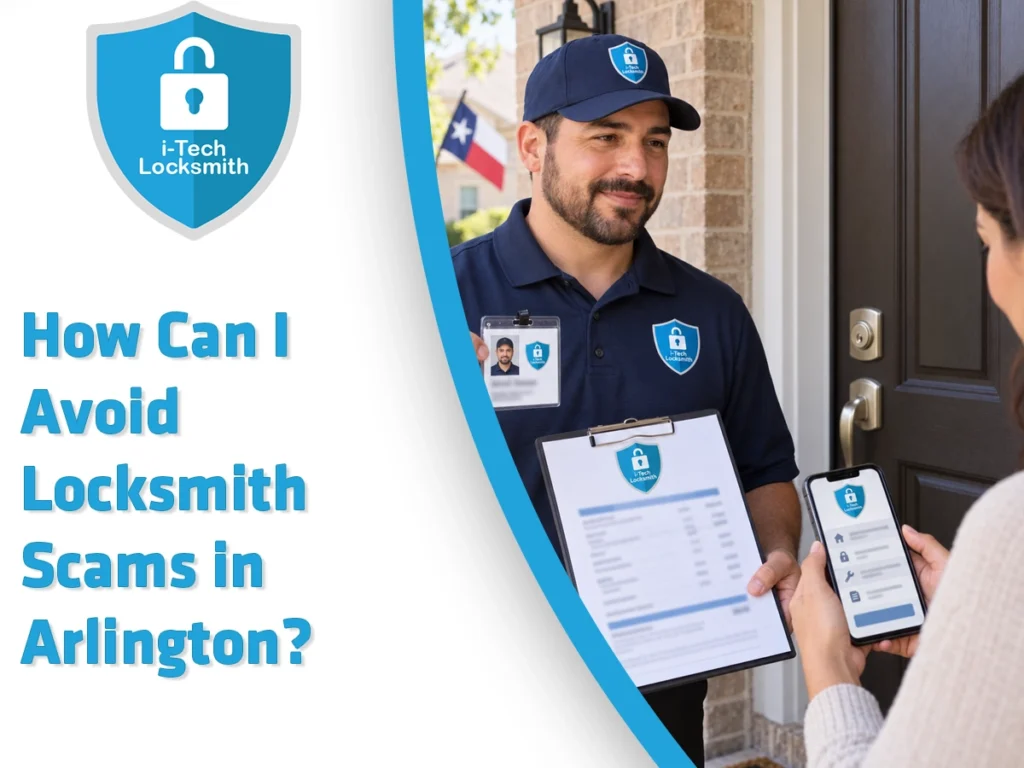
13 Powerful Checks for Safe and Honest Locksmith Service
Here is a surprising Texas fact: advertising services with the word “locksmith” counts as acting as a locksmith company. The Texas Department of Public Safety says unlicensed locksmith advertising violates state law. Therefore, a polished advertisement or top search position does not prove that a provider is legitimate. To avoid locksmith scams in Arlington, verify the company before dispatch, ask for a clear price structure, and approve a written estimate before any work begins.
AI Overview
To avoid locksmith scams in Arlington, slow the transaction down before the technician touches the lock. Confirm the business name, local contact details, Texas license information, technician identity, service scope, and price range. When the technician arrives, verify the company again and request a written estimate. Do not approve drilling, replacement, or extra work without a clear reason and updated price. Keep every message, photo, estimate, and receipt. If you suspect fraud or an unlicensed provider, stop the job when safe and report the issue to the proper agency.
- Verify the company, license, technician, service, and payment terms.
- Require written approval before work starts or the scope changes.
1. Check the Company Before You Request Dispatch
A stressful lockout can make the first search result feel like the only choice. However, search rank is not a license check. Paid advertisements can appear above established local businesses. Lead services may also answer with a generic name and pass the job to an unknown contractor.
First, ask the dispatcher for the complete company name. Then compare that name with the website, phone greeting, estimate, and payment receipt. Also ask whether the arriving technician works for the company or receives the job through a separate dispatch network.
Next, look for consistent business information. The website, directory profile, invoice name, and phone answer should make sense together. A small spelling difference may be harmless. Several unrelated names, changing phone numbers, or no clear company identity deserve more questions.
- Ask for the full legal or operating name before sharing your location.
- Confirm whether an employee or an independent contractor will arrive.
- Save the website, advertisement, phone number, and dispatch message.
A provider should answer basic identity questions without anger or pressure. If the person refuses, choose another company when there is no immediate safety danger.
2. Verify the Texas Locksmith License
Texas regulates locksmiths through the Department of Public Safety Private Security Program. Its Texas Online Private Security system provides current licensing information. Consumers can use the official TOPS license search guidance to check licensed companies and individuals.
Ask the company for its license number or enough exact information to find the record. Search the business name and, when needed, add a city, postal code, license type, or technician name. Then compare the result with the company you called.
Do not rely only on a license number printed in an advertisement. A number can be copied, expired, or linked to another company. The useful check is whether the official record matches the provider’s name and current status.
- Search the company through the Texas DPS licensing system.
- Compare the listed name and license details with the provider.
- Ask questions if the record is missing, expired, or belongs to another entity.
Licensing does not guarantee that every transaction will be perfect. Still, it creates an essential layer of identity and oversight that an anonymous listing does not provide.
3. Ask the Right Questions During the First Call
The first phone call should define the problem and the likely service. Tell dispatch whether you are locked out, lost every key, broke a key, have a damaged lock, or need a planned change. Give the property or vehicle type and any useful model details.
Then ask how the price is built. The dispatcher may need an on site inspection before giving a final total. Even so, the company should explain the service call fee, labor range, possible parts, after hours charges, taxes, and any cancellation fee.
Ask what situations would increase the price. For example, a damaged high security lock may require different work from a basic unlocked cylinder. Clear conditions are more useful than a vague promise that everything starts at a very low price.
- Ask what the quoted amount includes and excludes.
- Request the likely total range for the problem you described.
- Confirm arrival range, payment methods, and cancellation terms.
For a residential lockout benchmark, review what may affect the cost to unlock a house in Arlington. Your actual price can differ, but knowing the cost factors helps you ask better questions.
4. Treat an Extremely Low Quote as a Starting Point
A low price is not automatically dishonest. A simple task can cost less than a complex one. However, an unusually low figure becomes risky when the caller will not define it. Sometimes the advertised number covers only dispatch, while labor and parts remain unstated.
Ask the caller to name each possible charge. Repeat your understanding in plain words. For example, ask whether the quoted range includes opening the door and whether any trip fee is separate. Request confirmation by text or email when possible.
On arrival, do not let urgency replace the estimate. If the technician announces a much higher total, ask what new condition was found. A real change should connect to a visible issue, a different service, or information that was not available during dispatch.
- Separate the service call fee from labor, parts, and after hours charges.
- Ask whether the low advertised amount is a minimum or a likely total.
- Pause when the final estimate does not match the stated scope.
Our professional view is simple: a clear estimate protects both customer and technician. It creates one shared description of the problem, work, and price.
5. Match the Technician to the Company You Called
Before opening the door to a stranger, ask who has arrived. Compare the technician’s name, callback number, vehicle, and company with the dispatch details. A vehicle may not always carry large branding, yet the technician should still explain the connection clearly.
Ask to see suitable company identification and required license information. Do not hand over your driver license for an extended time or allow an unknown person to photograph unrelated personal data. The provider may need to verify your identity and authority, but that check should relate to the property or vehicle.
If the arriving person gives a different company name, call the original dispatcher. Confirm the assignment before authorizing access. If neither party can explain the relationship, cancel when safe and choose another provider.
- Compare the technician’s identity with your dispatch confirmation.
- Verify the company relationship before showing sensitive documents.
- Keep control of your identification whenever practical.
A responsible locksmith should also check that you may access the home, office, or vehicle. That two way verification is a sign of a safer process.
6. Require a Written Estimate Before Work Starts
The on site estimate is one of your strongest protections. It should identify the company, describe the work, list major charges, and show the expected total. Read it before signing. Do not accept blank spaces that can be completed later.
Make sure the estimate matches the problem you reported. Door opening does not automatically mean drilling and replacing the lock. Rekeying does not automatically mean new hardware. If several options exist, ask for the price and trade off of each choice.
If the scope changes, request a revised estimate before extra work begins. A technician may uncover hidden damage, yet the discovery should be explained. You should know what changed, why it matters, and how much the new work will cost.
- Read the service description, parts, labor, fees, and total.
- Cross out blank spaces or request a complete new estimate.
- Approve added work only after receiving an updated price.
This step supports smart action during an emergency lockout. Staying calm for two more minutes can prevent a long dispute later.
7. Question Drilling or Replacement Without Proof
Drilling can be necessary in some cases. A lock may be damaged, failed, or designed in a way that limits other options. Still, it should not be the unexplained first answer for every lockout. Drilling destroys or changes parts and can turn an entry job into a replacement job.
Ask the technician to explain why the proposed method fits your lock. Then ask whether a less destructive option is reasonable. You do not need technical bypass details. You need a clear service reason, the price, and the effect on your hardware.
Also inspect any replacement item before installation. Confirm the brand, finish, grade, key count, and warranty when those details matter. Keep the packaging or part description on the invoice.
- Ask why drilling or replacement is required for this lock.
- Request the full replacement price before destructive work begins.
- Confirm the exact hardware and warranty you will receive.
Be careful with do it yourself attempts as well. Poor tools or force can create real damage that makes professional service more complex. The same principle appears in this guide on why unplanned lock installation can fail.
8. Watch for Pressure and Unusual Payment Demands
Scammers often depend on urgency. The Federal Trade Commission warns that pressure to act immediately is a common scam sign. It also advises caution when someone insists on hard to reverse payment methods such as wire transfers, cryptocurrency, payment apps, or gift cards.
A locksmith may accept several valid forms of payment, including cash or a payment app. The concern is not one method by itself. The concern is pressure, a changed price, refusal to provide a receipt, or a demand that blocks reasonable review.
Before paying, compare the invoice with the approved estimate. Ask for an itemized receipt showing the company, date, service address or vehicle, work performed, parts, taxes, and total. Keep proof of payment.
- Refuse gift card, wire, or cryptocurrency demands tied to pressure.
- Review the completed work and invoice before paying.
- Request a detailed receipt under the same company name you hired.
Never share a card security code, bank login, or unrelated personal data. A normal service payment does not require access to your financial account.
9. Stay Extra Careful During a Night Lockout
Nighttime stress can weaken good judgment. First, move to a bright and occupied place when possible. If a child, vulnerable person, or immediate safety threat is involved, call 911. Property access should not delay emergency help.
Next, tell a trusted person where you are and which company you called. Share the technician’s name or dispatch details. Keep your phone charged, and do not wait in a traffic lane or isolated area merely to stay beside the lock.
Even at night, use the same checks. Verify the company and license. Confirm the price structure. Request the written estimate. A legitimate emergency does not remove your right to know who is working and what the service costs.
- Wait in a safe, bright location whenever circumstances allow.
- Share your location and provider details with someone you trust.
- Call emergency services first when personal safety is at risk.
Use this late night lockout safety guide to prepare before an after hours problem occurs.
10. Document the Work From Start to Finish
Good records help prevent confusion and support a complaint if needed. Save screenshots of the advertisement and website. Keep the dispatch text, call time, estimate, invoice, payment record, and technician information. Photograph the lock before work if it already has damage.
After the service, test the result while the technician is present. Open, close, lock, and unlock the door. If keys were made, test each key. If electronic access was changed, confirm the authorized credentials and basic function.
Do not sign a statement saying the work is complete if the lock does not function as agreed. Write any unresolved issue on the document or communicate it in a saved message. Then request the company’s correction process.
- Save advertisements, messages, estimates, photos, and receipts.
- Test every repaired lock, new key, and approved function.
- Record any problem before the technician leaves.
Documentation is useful for honest businesses too. It helps them understand the concern and respond with the correct service record.
11. Know What to Do if You Suspect a Scam
If something feels wrong before work begins, pause. Do not allow drilling, removal, or installation while the price and identity remain unclear. Ask the technician to leave if you have not authorized work. If you feel threatened, move to safety and call police.
If work has begun, avoid a physical argument. State that you do not approve added work or a changed price. Document the condition and contact the company through the number you verified. Keep all communication factual.
For possible licensing violations, the Texas DPS provides an official Private Security consumer complaint process. The agency says complaints may concern licensed or unlicensed people or companies. You may also report suspected fraud through the FTC and contact your payment provider promptly.
- Stop unauthorized work when it is safe to do so.
- Save evidence and contact the company in writing.
- Report licensing concerns, suspected fraud, threats, or property damage to the proper authority.
Do not make public claims that you cannot support. Instead, record dates, names, quotes, charges, work, and documents. Specific facts make a complaint more useful.
12. Illustrative Arlington Locksmith Scam Scenarios
The following cases are educational examples. They are not claims about named customers, companies, or completed I-Tech Locksmith jobs.
In the first case, an Arlington homeowner calls an advertisement that promises a very low price. The dispatcher will not explain whether it covers labor. On arrival, the price becomes several times higher before the lock is inspected. The homeowner pauses, refuses work, and calls another verified provider.
In the second case, a driver needs a replacement key. The technician identifies a different company than the one named during dispatch. The driver calls the original number and cannot confirm the relationship. Because the vehicle is safe, the driver cancels before sharing identification or approving service.
In the third case, a lock truly is damaged and requires replacement. The technician explains the condition, shows the customer the issue, offers clear options, and updates the written estimate. A higher price alone is not proof of a scam when the reason, scope, and consent are clear.
- Case one shows why a low quote must have a defined scope.
- Case two shows why technician identity must match dispatch.
- Case three shows how transparent changes differ from deceptive price changes.
These examples support one practical opinion: transparency matters more than a perfect phone quote. Conditions can change, but identity, explanation, and consent should remain clear.
13. Frequently Asked Questions About Locksmith Scams
How can I tell if a locksmith is legitimate in Arlington?
Ask for the complete company name and Texas license information. Check the provider through the state licensing system. Confirm the technician’s identity when they arrive. Also request a written estimate before work starts and an itemized receipt afterward. Consistent names, clear answers, ownership checks, and reasonable documentation are stronger signals than a search advertisement alone.
Are locksmiths required to be licensed in Texas?
Texas regulates locksmith companies and individuals through the Department of Public Safety Private Security Program. A provider advertising locksmith services should be connected to the proper licensing record. Because rules and status can change, use the official TOPS search instead of relying only on a license number displayed in an advertisement or on a vehicle.
Why did the locksmith price change after arrival?
A price can change when the technician finds hidden damage, a different lock type, or a service need that dispatch could not confirm. However, the provider should explain the discovery and give you a revised written estimate before extra work. A sudden increase without a clear reason, scope, or chance to decline is a warning sign.
What should I ask a locksmith before hiring them?
Ask for the company name, Texas license information, technician relationship, service call fee, labor range, possible parts, payment methods, arrival range, and cancellation policy. Describe the lock or key problem clearly. Then ask what could change the price. Save the answers and compare them with the written estimate presented before work begins.
Where can I report a locksmith scam in Texas?
Report possible locksmith licensing violations to the Texas Department of Public Safety Private Security Program. Suspected fraud can also be reported to the Federal Trade Commission. Contact local police for threats, theft, or immediate danger. In addition, notify your card issuer or payment service quickly and preserve advertisements, messages, estimates, invoices, photos, and payment records.
Choose Clarity Before Any Locksmith Work Begins
You can avoid locksmith scams in Arlington by verifying identity, checking the Texas license, defining the service, and approving the price in writing. Then watch for pressure, needless destructive work, mismatched company names, and payment demands that leave no clear record.
An urgent lock problem still allows a short verification process unless someone is in danger. Those few minutes protect your property, budget, and personal information. They also help an honest locksmith understand exactly what you expect.
Contact I-Tech Locksmith – Arlington to confirm current availability, license information, service scope, and pricing for your lock or key problem.
Contact us at
Phone: 817-383-1387
Location: 1738 W Division St, Arlington, TX 76012
Website: www.i-tech-locksmith.com