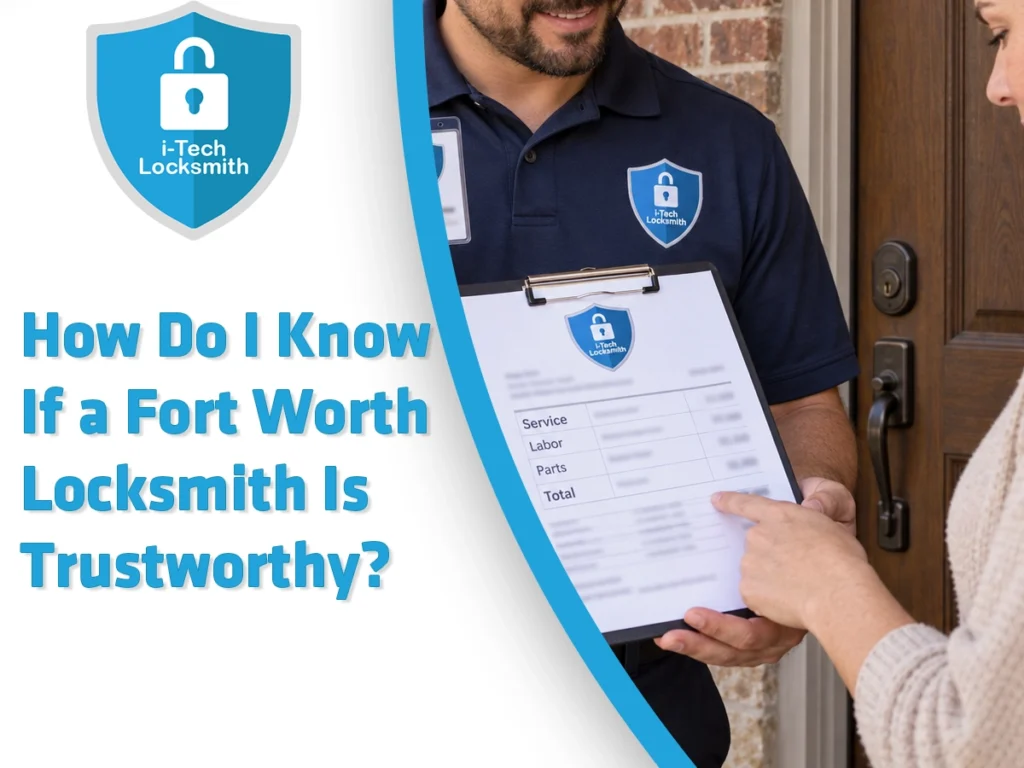
12 Powerful Signs of a Trustworthy Fort Worth Locksmith
Here is a surprising fact: Texas locksmith oversight goes beyond a business name and phone number. The Texas Department of Public Safety says its Private Security Program uses fingerprint based background checks, complaint review, disciplinary action, and enforcement against unlicensed activity. Locksmiths are included in that regulated field. Therefore, finding a trustworthy Fort Worth locksmith should start with official verification and continue with clear identity, pricing, authorization, workmanship, and records.
AI Overview
A trustworthy Fort Worth locksmith should be connected to a current Texas license record and a consistent company identity. Before dispatch, confirm the business name, technician relationship, likely service, arrival range, price structure, and payment terms. On arrival, verify the technician and expect the locksmith to check your authority to access the property or vehicle. Review a written estimate before work begins. A professional should explain the diagnosis, offer suitable options, protect the lock and surrounding property, document parts and keys, test the result, and provide an itemized invoice.
- Verify the company, license, technician, service, and estimate.
- Look for consistent professional behavior from the first call through final testing.
1. Verify the Texas Locksmith License
A license is not the only sign of trust, yet it is the first objective check. Texas regulates locksmith companies and individuals through the Department of Public Safety Private Security Program. Do not rely only on a license number printed in an advertisement.
Ask for the complete company name and license information. Then use the state’s TOPS license search guidance to find the record. Compare the name, license type, and current information with the company you called.
If the search returns no match, confirm the spelling and try more details. The state notes that users may need to add a name, license number, location, or license type. A provider should help resolve a reasonable question rather than pressure you to ignore it.
- Search official Texas records before planned service when possible.
- Match the license information with the exact company and technician.
- Ask for clarification when a record is missing, expired, or inconsistent.
Licensing creates oversight and accountability. However, customers should still evaluate the actual transaction and quality of work.
2. Confirm a Consistent Company Identity
Trust becomes difficult when several company names appear during one job. The name used by dispatch should connect clearly with the website, technician, estimate, payment record, and invoice. A contractor relationship can be legitimate, but it should be explained.
Ask whether the arriving person is an employee or receives work through a dispatch network. Request the technician’s name and vehicle description when available. When the technician arrives, compare those details before sharing sensitive documents or allowing work.
A plain vehicle is not automatic proof of a problem. Small companies and contractors may use different vehicles. The key issue is whether identity, license, dispatch, and paperwork form one understandable chain.
- Record the company name and callback number during dispatch.
- Confirm who will arrive and how that person relates to the company.
- Match the estimate and receipt to the provider you hired.
If the relationship cannot be confirmed, pause. Call the original company before authorizing access or payment.
3. Judge the Quality of the First Conversation
A trustworthy dispatcher asks questions before promising a solution. The company should want to know whether the problem involves a home, business, vehicle, safe, gate, or electronic system. It should also ask whether the door is locked, the key is lost, or the hardware is damaged.
Clear questions help send the right technician and equipment. They also create a more useful price range. A caller who promises one universal price without learning anything may be describing only a service call or minimum charge.
Pay attention to tone as well. Calm explanations are a positive sign. Pressure, insults, threats, or refusal to answer basic identity and price questions are not normal professional communication.
- Expect questions about the lock, key, property, and current condition.
- Ask the dispatcher to explain the likely service and price structure.
- Choose calm, specific communication over pressure and vague promises.
For urgent situations, these steps for staying calm during a lockout can help you think clearly while arranging service.
4. Match the Locksmith’s Experience to the Job
Trust also depends on competence. A residential deadbolt, commercial master key system, vehicle proximity fob, and safe lock are not the same service. Ask whether the assigned technician regularly handles your type of problem.
Describe the system as clearly as possible. For a vehicle, give the year, make, model, and key type. For a business, mention the door, cylinder, exit hardware, access control, or restricted key system. For a home, explain whether you need entry, repair, rekeying, or replacement.
A trustworthy provider can also admit limits. Some work may require manufacturer parts, special authorization, another specialist, or a dealership. A careful referral is more credible than a claim that one person can solve every system without inspection.
- Confirm experience with the exact lock or key category.
- Ask whether the technician has the required equipment and parts.
- Respect a clear referral when the job falls outside the provider’s scope.
Professional confidence sounds specific. It does not depend on exaggerated guarantees.
5. Expect Two Way Identity and Ownership Checks
A locksmith controls access to homes, offices, vehicles, and protected rooms. Therefore, the customer should verify the technician, and the technician should verify the customer’s authority. That two way check is a strong trust signal.
Prepare photo identification and proof connected to the property or vehicle. If the document is locked inside, explain that before dispatch. Rental agreements, company authorization, registration, insurance records, or contact with the owner may help in special cases.
The provider should collect only information relevant to authorization and the service record. Do not give an unknown person unrelated financial data, passwords, alarm codes, or copies of documents without a clear need.
- Verify the technician before presenting personal records.
- Prepare proof of ownership or authorized access.
- Limit shared information to what the service reasonably requires.
A provider willing to open any lock without checking authority should concern both property owners and managers.
6. Look for Diagnosis Before Replacement
A trustworthy locksmith should inspect the cause before recommending major work. A stiff deadbolt may come from door alignment. A key problem may involve wear or a poor duplicate. An electronic lock may have battery, installation, alignment, or programming issues.
Ask the technician to explain what was observed and how the proposed service addresses it. When practical, the locksmith can show the binding bolt, damaged cylinder, worn key, loose hardware, or failed component without exposing sensitive security details.
Next, ask about reasonable options. Repair, alignment, rekeying, and replacement have different benefits. The provider should not present the most expensive option as the only choice unless the condition truly leaves no suitable alternative.
- Request a clear diagnosis connected to visible or tested facts.
- Ask how the proposed work solves the underlying problem.
- Compare repair, rekeying, and replacement when several options are valid.
This guide to common lock problems and prevention explains why the full door and hardware system may need attention.
7. Require a Written Estimate Before Work
Trustworthy service makes the scope and price visible before work begins. The estimate should identify the company, describe the service, list major charges, and show the expected total. Read it carefully and do not sign a form with important blank spaces.
Ask about the service call, labor, parts, emergency fees, travel, taxes, payment methods, and cancellation terms. A final price may require inspection, yet the company should explain what could change the amount.
If a new problem appears, the technician should pause. Ask for a revised estimate before added work. Authorization to open a door does not automatically approve drilling, replacement, extra keys, or electronic programming.
- Review the complete service and price before tools touch the lock.
- Separate dispatch, labor, parts, programming, and added fees.
- Approve every scope or price change in writing.
Price clarity supports trust because both sides can compare the completed work with the original agreement.
8. Expect Careful Methods and Property Protection
A professional locksmith should assess the least damaging suitable approach. That does not mean drilling is never needed. Damaged, failed, or specialized hardware may require destructive work. However, the reason should be explained before the method changes the lock.
Observe how the technician protects paint, trim, glass, weather seals, wiring, and nearby surfaces. The work area should be controlled. Existing damage should be noted before service when it could cause confusion later.
After access or repair, inspect the result. Test the door, lock, handles, keys, remote, or access credentials. If a vehicle key was programmed, confirm that every supplied function works before the technician leaves.
- Ask why the proposed method fits the lock and condition.
- Approve drilling or replacement only after explanation and pricing.
- Inspect and test the finished work with the technician present.
Damage free entry cannot be guaranteed in every case. Trustworthy service explains the realistic goal and known risks instead of making an absolute promise.
9. Check Hardware, Keys, and Access Records
When parts are installed, ask what you are receiving. The estimate or invoice should identify the lock, cylinder, key, remote, credential, or other major component. Confirm the brand, model, finish, quantity, and warranty when those details matter.
For rekeying, count the cylinders and new keys. For a business, review master key levels, restricted key authorization, and issued key records. For vehicles, confirm whether the service includes a mechanical blade, transponder, remote, proximity fob, or programming.
Do not leave sensitive key codes or access plans exposed. A trustworthy provider should respect key control and return or dispose of removed parts according to the approved plan.
- Match installed hardware and key quantities with the estimate.
- Test every new key, remote, or access credential.
- Protect key codes, access records, and authorization data.
For stronger residential hardware, review the benefits and limits of high security locks before choosing an upgrade.
10. Read Reviews for Patterns, Not Perfection
Reviews can provide useful context, but one review does not prove trust or dishonesty. Look for repeated patterns across recent comments. Arrival communication, price consistency, property care, receipts, and problem resolution matter more than generic praise.
Read critical reviews closely. Did the company answer with facts and a proposed solution, or did it attack the customer? Also consider whether several reviews use nearly identical language or lack meaningful service details.
Local presence should be checked with the same care. A Fort Worth area address, local page, or map listing can help, yet none replaces licensing and transaction checks. Compare the public details with the company that actually answers.
- Look for consistent service details across recent reviews.
- Evaluate how the company responds to reasonable complaints.
- Confirm local and company information through more than one source.
Reviews are supporting evidence. They work best alongside official records, clear communication, and good paperwork.
11. Expect an Itemized Invoice and Clear Follow Through
The final invoice should match the approved estimate and any documented changes. It should identify the company, date, service, labor, parts, taxes, and total. Payment should go to the company or approved recipient explained during the transaction.
Ask for written warranty terms when a warranty applies. The document should explain what is covered, how long coverage lasts, and whom to contact. Save photos, estimates, invoices, receipts, key details, and messages in one place.
If a problem appears, contact the company with the service date and invoice. A trustworthy response begins by reviewing the record and defining the next step. Not every issue proves poor work, but every concern deserves a clear process.
- Compare the invoice with every approved estimate.
- Keep written warranty and follow up information.
- Save records that allow the company to review the job.
Professional trust continues after payment. Good documentation makes that follow through possible.
12. Recognize Pressure and Know When to Stop
The Federal Trade Commission identifies immediate pressure and demands for unusual payment methods as common scam signs. During locksmith service, pause if someone refuses identity checks, changes the price without explanation, threatens you, or demands payment for work you did not approve.
When safe, stop the job before drilling, removal, or installation continues. Contact the original company through a number you verified. If you feel threatened or face an immediate danger, move to safety and call police.
Keep advertisements, messages, estimates, photos, invoices, and payment records. Licensing concerns may be reported through Texas DPS, while suspected fraud may also be reported to consumer authorities.
- Stop unauthorized work when it is safe to do so.
- Preserve clear records of names, dates, scope, and payment.
- Report threats, suspected fraud, or licensing concerns to the proper agency.
For a focused warning list, read this guide to recognizing locksmith scams.
Illustrative Trustworthy Locksmith Scenarios
These examples are educational. They are not claims about named customers or completed I-Tech Locksmith jobs.
In the first case, a Fort Worth homeowner is locked out. Dispatch confirms the company, service call, range, and technician. On arrival, the locksmith verifies ownership, inspects the cylinder, presents an estimate, completes entry, and tests the lock with the customer.
In the second case, a manager requests rekeying after staff changes. The locksmith reviews door counts, key levels, authorizes, and return records. One cylinder is damaged, so the technician provides options and waits for written approval before replacing it.
In the third case, a driver requests a new key. The automotive locksmith confirms the vehicle and ownership, explains cutting and programming, provides a written estimate, tests every function, and records the supplied key on the invoice.
- The first case shows consistent identity, pricing, and ownership checks.
- The second case shows controlled commercial authorization.
- The third case shows clear automotive scope and testing.
These examples show our professional view of trust: it is a repeatable process, not a slogan or one friendly conversation.
Frequently Asked Questions About Trustworthy Locksmiths
How can I verify a locksmith’s license in Fort Worth?
Ask for the company’s exact name and Texas license information. Then use the Texas Online Private Security license search linked through the Department of Public Safety. Compare the record with the provider you called and the technician who arrives. If information does not match, pause and ask the company to explain the relationship before work begins.
What should a trustworthy locksmith provide before starting?
A trustworthy locksmith should provide a clear identity, confirm the service, verify your authority, inspect the problem, and present a written estimate. The estimate should describe labor, parts, likely fees, and total price. When conditions change, the technician should explain the new issue and receive your approval before completing added or destructive work.
Is a locksmith trustworthy if the vehicle has no company logo?
Not necessarily, but a plain vehicle is not proof of dishonesty either. Verify the technician through the company you called. Compare the name, callback number, license information, identification, estimate, and payment recipient. A clear contractor relationship can be legitimate. An unexplained identity mismatch is a reason to pause and confirm the assignment.
Should a locksmith ask for proof that I own the property?
Yes. A responsible locksmith should verify that you own the home or vehicle or have permission to request access. Prepare identification, registration, a lease, company authorization, or another suitable record. If documents are locked inside, tell dispatch. Careful ownership checks protect customers and show that the provider treats access authority seriously.
What should I do if a locksmith changes the price?
Ask what new condition changed the service and request a revised written estimate. A price change can be reasonable when inspection reveals damage, specialized hardware, or a different key system. However, added work should not begin without your approval. If the explanation remains vague or pressure starts, stop the job when safe and preserve the records.
Choose a Locksmith Through Evidence, Not Promises
A trustworthy Fort Worth locksmith should be verifiable, clear, careful, and accountable. Check the Texas license and company identity. Then evaluate communication, ownership verification, diagnosis, written pricing, work methods, parts, testing, invoices, and follow through.
No single badge, review, or low quote proves trust. Instead, look for consistent evidence at every stage. That process helps protect your property, personal information, access control, and budget.
Contact I-Tech Locksmith – Fort Worth to confirm current availability, licensing information, service scope, and pricing for your lock or key problem.
Contact us at
Phone: 817-663-0642
Location: 8520 Tamar Trail, Fort Worth, TX 76118
Website: www.i-tech-locksmith.com