
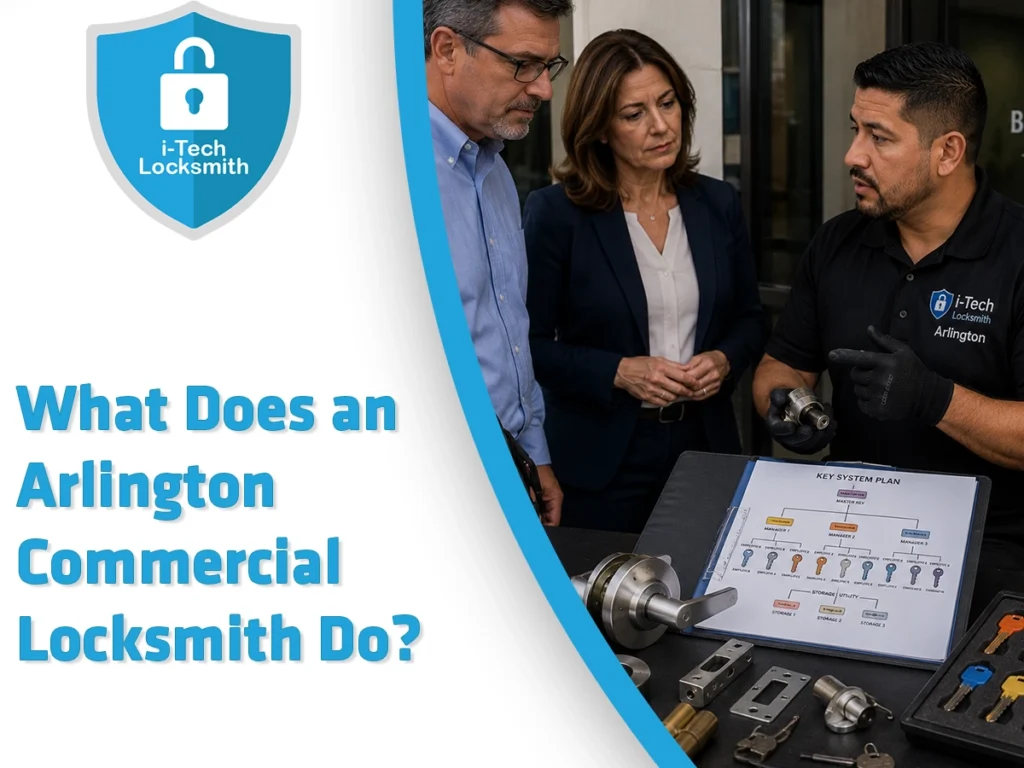
Ways a Commercial Locksmith Protects a Business
A commercial locksmith does much more than open a locked office door. The work can involve every lock, key, cylinder, entrance, restricted room, and access level across an entire business property.
AI Overview
An Arlington commercial locksmith helps local businesses control who can enter their buildings and restricted work areas. Common services include business lockouts, lock repair, commercial rekeying, lock replacement, master key systems, key control planning, panic hardware service, and access control installation.
A locksmith may also inspect commercial doors after an employee leaves, a key disappears, a tenant changes, or an attempted break in damages the hardware. In addition, the locksmith can assess whether existing locks remain safe or whether stronger cylinders and door hardware are needed.
Commercial locksmith work should begin with an inspection. The technician should identify the lock type, door condition, access needs, and reason for service. Then, the business should receive a clear explanation of the available options before approving the work.
However, a locksmith cannot solve every security issue with a new cylinder. A weak frame, damaged strike plate, failing closer, poor door alignment, or unsafe exit setup may also need attention. Therefore, commercial security decisions should consider the complete door and how people use it each day.
1. An Arlington Commercial Locksmith Opens Locked Businesses
Business lockouts can stop employees from entering offices, stores, warehouses, or service areas. As a result, even a short delay may affect staff, customers, deliveries, and scheduled work.
A commercial locksmith may help when:
- A manager leaves the office key at home
- A key breaks inside the entrance lock
- The lock cylinder stops turning
- An electronic credential fails
- A rear service door becomes stuck
- A key is lost during a shift change
Before opening the door, the locksmith should verify that the requester has authority to enter the property. This step protects the business and helps prevent access by an unauthorized person.
Verification may involve:
- Government issued identification
- Business identification
- Lease or ownership information
- Approval from an authorized manager
- Confirmation from a property representative
After authorization, the technician should inspect the lock and choose the safest practical entry method. Drilling should not be the automatic first step because many lockouts may have less destructive solutions.
However, the correct method depends on the lock, damage, door design, and surrounding hardware. A responsible technician should explain the approach before beginning.
Once the door opens, the locksmith should test the lock again. If a worn key, failed cylinder, or alignment problem caused the lockout, that issue should be addressed before the service ends.
2. A Commercial Locksmith Rekeys Office Locks
Rekeying changes the internal key combination of a compatible lock. Therefore, the old key stops working while the current hardware may remain installed.
Businesses often request rekeying after:
- An employee leaves without returning a key
- A company moves into a new office
- A contractor finishes a project
- A business key is lost or stolen
- Managers cannot account for old copies
- A tenant leaves a commercial suite
Rekeying can restore key control without replacing every usable lock. However, it does not repair weak or damaged hardware.
The locksmith should inspect:
- The cylinder condition
- The keyway and lock brand
- The latch or deadbolt
- The door alignment
- The strike plate
- The frame around the lock
If the hardware remains safe and compatible, rekeying may offer a practical solution. Conversely, replacement may be better when the cylinder is worn, damaged, outdated, or unsuitable for the business.
The decision should be based on the actual condition of each opening. Therefore, the locksmith should not recommend complete replacement without a clear reason.
For a more detailed comparison, businesses can review this guide to rekeying versus replacing locks.
3. Commercial Locksmiths Repair Failing Business Locks
A failing lock often gives warning signs before it stops working completely. Unfortunately, those signs may be ignored until an employee cannot secure or open the door.
Common warning signs include:
- A key that sticks during every turn
- A cylinder that feels loose
- A latch that does not enter the strike
- A deadbolt that requires force
- A lever that sags or fails to return
- A lock that works only when the door is pushed
A commercial locksmith should diagnose the cause instead of treating every problem as a failed cylinder.
For example, a deadbolt may appear broken when the real problem is door movement. Likewise, a key may feel difficult because the cylinder is worn or the key itself is damaged.
A complete inspection may cover:
- Lock operation with the door open
- Lock operation with the door closed
- Key wear
- Cylinder movement
- Latch alignment
- Door sag
- Frame condition
- Strike plate placement
Once the cause is clear, the locksmith can explain whether adjustment, repair, rekeying, or replacement is appropriate.
Ignoring a failing lock can create more damage. It may also leave an exterior door unable to latch securely.
This article about the cost of ignoring a faulty lock explains why early service can be important.
4. Locksmiths Replace Damaged or Outdated Hardware
Some commercial locks should not remain in service. A badly worn, forced, loose, or unsuitable lock may need full replacement.
Replacement may be appropriate when:
- The lock was damaged during forced entry
- Internal parts are worn beyond repair
- The hardware no longer fits the security risk
- Replacement parts are unavailable
- The business wants stronger key control
- The current lock does not work reliably
A commercial locksmith should explain why new hardware is being recommended. In addition, the estimate should identify required repairs separately from optional upgrades.
The locksmith may discuss:
- Commercial grade lever locks
- Mortise lock hardware
- Deadbolt options
- Interchangeable core cylinders
- Restricted key systems
- Electronic access products
- High security cylinders
However, the strongest lock is not always the correct lock. Hardware must fit the door, frame, traffic level, access plan, and exit requirements.
The technician should also inspect the strike plate and fasteners. A new lock may still perform poorly when the frame is weak or the door no longer aligns.
Business owners can review common replacement signs in this guide about when locks should be replaced.
5. A Locksmith Builds Master Key Systems
A master key system allows different keys to open different groups of locks. As a result, a business can give each person the access required for that person’s role.
A basic system may include:
- Employee keys for assigned work areas
- Department keys for supervisors
- A master key for approved managers
- A higher access key for property leadership
For example, a general employee may open the main entrance and one work area. Meanwhile, a manager may use one key for several offices, storage spaces, and service doors.
A planned system can help:
- Reduce large key rings
- Separate restricted areas
- Simplify management access
- Support employee role changes
- Organize several commercial doors
- Improve key issue records
However, master keys require careful control. A lost master key may affect several doors instead of one.
Therefore, the business should limit how many master keys exist. Each key should be recorded, issued to an approved person, and stored securely when not in use.
The locksmith should create an access chart before keying the locks. That chart should show which key level opens each door.
6. Locksmiths Improve Business Key Control
A locked door provides limited protection when managers do not know how many working keys exist. Key control is the process of tracking who has each key and what that key opens.
CISA recommends controlling workplace entry and maintaining an inventory of keys, access cards, badges, and related access items. It also advises organizations to report broken doors, windows, and locks promptly.
A commercial locksmith can help a business organize:
- Numbered keys
- Key issue records
- Access levels
- Spare key storage
- Key return procedures
- Copy authorization rules
A useful record may include:
- The key holder’s name
- The key number
- The doors it opens
- The approval date
- The person who approved it
- The return date
This process becomes especially important when a business has frequent employee, vendor, or tenant changes.
The business should also review how keys are labeled. A full business name, address, and room description may reveal too much information if the key is lost.
Instead, a controlled code can help managers identify the key without clearly advertising its purpose.
7. An Arlington Commercial Locksmith Handles Employee Changes
Employee departures can create uncertainty about business access. Even when a key is returned, managers may not know whether another copy exists.
Most former employees do not create security problems. However, a business should use a consistent access policy rather than relying only on trust.
A locksmith may help after:
- A manager leaves the company
- A key is not returned
- An employee leaves without notice
- A worker had access to sensitive rooms
- A master key cannot be located
- Key records are incomplete
First, the business should identify every door the employee could open. Next, the locksmith can determine which cylinders belong to that access group.
The company may only need to rekey selected doors. However, a missing master key may require a wider response.
A strong departure process should also include:
- Collecting physical keys
- Canceling electronic credentials
- Changing shared door codes
- Reviewing lockboxes
- Updating the key inventory
- Removing old access permissions
For companies that use seasonal or temporary workers, this guide to temporary employee access solutions provides additional planning ideas.
8. Locksmiths Install and Service Access Control
Mechanical keys remain useful, but some businesses need more control. Electronic access can allow managers to issue, change, or cancel credentials without rekeying each door.
Common access methods may include:
- Keypad codes
- Proximity cards
- Electronic fobs
- Mobile credentials
- Electric strikes
- Magnetic locks
Electronic access may help when:
- Staff changes occur often
- Entry records are important
- Access should work only during set hours
- Several employees use one entrance
- Managers need faster credential removal
- A business wants fewer physical keys
However, access control is more than attaching a keypad to a door. The complete system may involve power, wiring, locking hardware, credential management, door position, and exit operation.
CISA describes facility access control as a full process that covers employee and visitor entry, screening, authentication, and entry into nonpublic areas. Although its detailed document is aimed at federal facilities, the planning concepts can help businesses evaluate their own access needs.
A locksmith should explain how the system locks, unlocks, and releases from the inside. The business should also know what occurs during a power or system failure.
9. Commercial Locksmiths Service Exit Door Hardware
Commercial doors may serve as both security barriers and emergency exits. Therefore, changes to those doors must consider safe exit as well as outside access.
OSHA states that workplace exit routes must remain continuous and unobstructed. Its standards also address exit route door design, visibility, safeguards, and operation.
A commercial locksmith may inspect or service:
- Panic bars
- Exit devices
- Exterior trim
- Lock cylinders
- Door closers
- Latches
- Strikes
- Related access hardware
Common problems include:
- A panic bar that sticks
- A door that does not latch
- Exterior trim that will not unlock
- A closer that slams the door
- A latch that drags against the strike
- A door that remains partly open
The technician should avoid changes that interfere with required exit operation. Moreover, complex fire rated or code related work may require coordination with other qualified door, fire, alarm, or access control professionals.
The goal is to keep unauthorized people from entering while allowing occupants to leave safely.
10. Locksmiths Help After Break Ins and Forced Entry
An attempted break in can damage more than the lock cylinder. The door, strike, frame, latch, and surrounding material may also be weakened.
After law enforcement releases the scene, a commercial locksmith can inspect:
- Forced cylinders
- Bent latches
- Damaged deadbolts
- Loose strike plates
- Cracked door frames
- Pried doors
- Broken keys
- Interior restricted locks
The service may involve:
- Temporary securing
- Cylinder replacement
- Lock replacement
- Rekeying unaffected locks
- Strike reinforcement
- Key control review
However, the business should not assume that replacing the cylinder restores the entire entrance. A new lock may not provide reliable protection when the frame remains cracked.
The locksmith should explain which issues require immediate repair and which upgrades are optional.
After the door is secured, management should also review whether any keys, records, devices, or credentials were taken.
For additional guidance, review this article about deciding whether to rekey or replace locks after a break in.
11. Commercial Locksmiths Secure Storefront Doors
Retail and storefront entrances often experience frequent use. Therefore, even good hardware may wear faster than locks on low traffic interior doors.
Storefront problems may include:
- A narrow stile lock that becomes hard to turn
- A hook bolt that no longer aligns
- A door that drags against the frame
- A cylinder that spins or feels loose
- A key that breaks from repeated force
- A door that fails to close fully
The locksmith should test the opening during normal operation. This includes checking how the door moves, closes, latches, locks, and unlocks.
A storefront inspection may cover:
- Entrance cylinders
- Rear delivery doors
- Employee entrances
- Stockroom locks
- Cash office doors
- Interior storage areas
Retail businesses should also review access before major sales periods, inventory deliveries, and seasonal staff changes.
A strong plan does not give every employee the same key. Instead, access should match job duties.
Managers may need broader access, while temporary workers may only need selected doors during approved hours.
12. Locksmiths Support Offices and Professional Spaces
Professional offices often contain records, devices, private rooms, and employee information. Therefore, interior access can matter as much as the front entrance.
An Arlington commercial locksmith may help secure:
- Private offices
- File rooms
- Supply closets
- Network rooms
- Management areas
- Employee entrances
- Storage rooms
- Shared suites
The business may need different access levels for:
- General staff
- Department managers
- Cleaning personnel
- Technology vendors
- Building maintenance
- Senior management
Rekeying may be useful when moving into a new suite because prior tenants, contractors, or vendors may still have copies.
Before changing locks in a leased property, the tenant should review the lease and speak with property management. Exterior doors may be part of a building wide system.
A locksmith can then coordinate the work with the authorized decision maker and preserve any required management access.
13. Locksmiths Help Warehouses Control Access
Warehouses may have several exterior doors, loading areas, offices, cages, tool rooms, and equipment spaces. Consequently, one general key may provide more access than employees need.
A warehouse access review may include:
- Main employee entrances
- Loading doors
- Office doors
- Inventory cages
- Tool storage
- Equipment rooms
- Exterior gates
- Manager areas
The locksmith can help organize the property by role. For example, shipping staff may need loading access, while office employees may not.
Likewise, outside drivers may need access to one delivery point but not the warehouse interior.
A master key system, restricted key system, or electronic access plan may help separate these areas.
However, hardware must match the environment. Dust, weather, heavy use, door movement, and impact can affect lock performance.
Therefore, warehouse locks should receive regular testing rather than service only after complete failure.
14. Locksmiths Assist Property Managers
Property managers may oversee several suites, tenants, common doors, utility spaces, and service areas. A disorganized key system can become difficult to control as tenants change.
A commercial locksmith may help with:
- Tenant turnover rekeying
- Suite lock changes
- Master key planning
- Common area access
- Maintenance keys
- Vacant unit security
- Key inventory updates
- Damaged lock replacement
Before each tenant change, management should confirm:
- Which keys were returned
- Which doors belong to the suite
- Whether old copies may exist
- Which management keys must continue working
- Whether the lock hardware remains safe
A structured master key system can allow tenant keys to remain limited while property managers retain approved access.
However, property access must follow lease terms, notice rules, and applicable law. A locksmith provides lock and access services but does not decide when a landlord has legal authority to enter.
15. Locksmiths Evaluate High Security Lock Options
A business may request high security locks after a key control concern, break in, insurance review, or change in protected assets.
The term high security should not be used as an empty sales phrase. The locksmith should explain the actual features of the recommended product.
Those features may include:
- Stronger cylinder construction
- Resistance to common attack methods
- Restricted key duplication
- Controlled key blanks
- Improved drill resistance
- More detailed authorization procedures
However, a strong cylinder cannot correct every weakness. The door, frame, latch, strike, hinges, and surrounding structure still matter.
Before recommending an upgrade, the locksmith should ask:
- What does the business need to protect?
- Which doors face the greatest risk?
- How many employees need keys?
- How often do staff roles change?
- Is unauthorized copying a concern?
- Does the business need entry records?
The answer may be a stronger mechanical system, electronic access, improved door hardware, or a combination of measures.
CISA provides physical security resources for organizations seeking to assess facilities and select protective measures that match their risks.
16. Locksmiths Help Businesses Prepare for Emergencies
Security planning should occur before a lock fails. An emergency plan can reduce confusion during a lockout, key loss, break in, or access system failure.
A useful plan may identify:
- Authorized emergency contacts
- Backup key locations
- Approved locksmith information
- Doors that protect critical areas
- Master key holders
- Property management contacts
- Alarm system procedures
- Employee reporting steps
The business should avoid hiding spare keys near exterior doors. Instead, backups should remain in controlled storage with an approved person or secure process.
Managers should also know which doors are required exits. Those doors must not be altered in a way that blocks safe evacuation.
For alarms intended to summon police, the City of Arlington states that residences and businesses must maintain a valid alarm permit. Business owners should verify current requirements through the official city page.
An emergency plan should be reviewed after major staff, property, or security changes.
17. A Commercial Locksmith Performs Security Assessments
A commercial lock assessment reviews how physical access works across the property. It is not simply a sales visit for new locks.
The locksmith may examine:
- Exterior entrances
- Interior restricted doors
- Lock condition
- Key control
- Door alignment
- Strike plates
- Master key needs
- Access control options
The process should begin with questions.
For example:
- Who needs access to each area?
- Which doors have recurring problems?
- Have any keys been lost?
- Are old employees still on the key list?
- Which rooms contain sensitive assets?
- Does the business expect to grow?
After the inspection, the locksmith should organize recommendations by priority.
Immediate concerns may include:
- Doors that do not latch
- Missing keys
- Broken cylinders
- Forced hardware
- Unsafe exit conditions
- Uncontrolled master keys
Longer term improvements may include:
- Better key records
- Restricted key systems
- Master key planning
- Electronic access
- Hardware standardization
- Scheduled maintenance
This approach helps decision makers address urgent risks first without treating every door as the same problem.
18. Locksmiths Can Standardize Commercial Hardware
Businesses sometimes expand without a hardware plan. One entrance uses one brand, interior doors use another, and added rooms use unrelated cylinders.
This mixture can make service, key control, and replacement more difficult.
Standardization may help:
- Simplify future maintenance
- Reduce the number of keyways
- Support master key planning
- Improve replacement part availability
- Make employee access easier to understand
- Create a consistent security policy
However, replacing functional locks only for visual matching may not provide enough value.
The locksmith should first identify:
- Which locks are compatible
- Which hardware is failing
- Which doors need different functions
- Which products support future growth
- Which openings require specialized hardware
Then, the company can create a staged plan instead of replacing everything at once.
Standardization should improve control and serviceability. It should not force every door to use identical hardware when those doors serve different purposes.
19. Commercial Locksmiths Protect New Business Locations
A new business owner may receive keys from a landlord, seller, contractor, or prior manager. However, receiving a set of keys does not prove that every old copy was collected.
Before opening a new Arlington location, the company should review:
- Main entrance locks
- Rear delivery doors
- Employee entrances
- Interior offices
- Storage rooms
- Utility rooms
- Gates
- Shared access points
The business should also confirm whether the property has:
- A master key system
- Shared building access
- Electronic credentials
- Alarm codes
- Vendor keys
- Lockboxes
Rekeying may create a clean starting point when the existing hardware remains usable. Meanwhile, damaged or outdated locks may need replacement.
The access plan should be completed before keys are distributed widely. Otherwise, the business may need to correct poor access choices soon after opening.
20. Locksmiths Explain the Best Option Before Work
Commercial locksmith service should include clear communication. The decision maker needs to understand the problem, available choices, and expected result.
Before beginning, the locksmith should explain:
- What was found
- Which service is recommended
- Why that service is appropriate
- Whether drilling is necessary
- Which parts may be replaced
- What the work should accomplish
- How the completed lock will be tested
The business should also receive clear pricing before approving the service.
An estimate may change if hidden damage becomes visible after disassembly. However, the locksmith should explain the new finding and obtain approval before adding work.
After service, the technician should:
- Test every affected key
- Test the lock with the door open
- Test the lock with the door closed
- Confirm that the latch holds
- Verify employee access levels
- Clean the work area
- Provide an invoice
This process allows the business to confirm that the service solved the original problem.
21. A Practical Commercial Locksmith Example
Consider a hypothetical Arlington office with a main entrance, rear employee door, records room, storage room, and manager’s office.
The business has three concerns:
- A former supervisor did not return a key
- The main entrance lock sticks
- Too many employees can enter the records room
A reasonable commercial locksmith process would begin with authorization and a door inspection.
Next, the locksmith could:
- Identify which locks accept the missing key
- Test the entrance lock and door alignment
- Review who needs records room access
- Explain rekeying and replacement choices
- Create a limited access plan
- Test every completed door
The final solution might include rekeying selected cylinders, repairing the entrance hardware, and creating separate employee and management keys.
However, the correct service would depend on the actual hardware and inspection findings.
This example shows a decision process. It does not describe a verified I-Tech Locksmith – Arlington project or customer.
22. How to Choose an Arlington Commercial Locksmith
A locksmith may receive temporary access to important areas and detailed information about the key system. Therefore, businesses should evaluate the provider carefully.
Ask whether the locksmith will:
- Verify authority before entry
- Inspect the complete door
- Explain available options
- Provide clear pricing
- Protect surrounding hardware
- Test the completed work
- Document installed keys or cylinders
- Explain future maintenance
Avoid providers who:
- Refuse to explain the work
- Recommend drilling before inspection
- Give only a vague starting price
- Push unnecessary replacement
- Cannot explain key control
- Leave doors untested
- Ignore exit safety
- Demand approval without a clear scope
A professional commercial locksmith should help the decision maker understand both the immediate repair and its effect on wider business access.
Frequently Asked Questions
What services does a commercial locksmith provide?
A commercial locksmith may open locked business doors, repair failing locks, rekey cylinders, replace damaged hardware, create master key systems, and improve key control. Some locksmiths also install or service electronic access products, panic hardware, storefront locks, and restricted key systems.
Can a commercial locksmith rekey all business doors to one key?
Many compatible commercial locks can be rekeyed so one approved key opens several doors. However, the locksmith must inspect the brands, cylinder formats, keyways, and hardware condition first. Some locks may be incompatible or may need replacement before they can join the planned system.
When should a business change or rekey its locks?
A business should review its locks after lost keys, staff departures, tenant changes, break ins, contractor access, or uncertain key records. Rekeying may be enough when the hardware remains safe. Damaged, outdated, or unsuitable locks may require full replacement instead.
Can a locksmith install access control for an office?
A qualified commercial locksmith may install or service certain access control components, including keypads, electric strikes, electronic locks, and credential systems. Complex projects may also require low voltage, fire, alarm, door, or security specialists, depending on the system and local requirements.
How does a commercial locksmith verify business ownership?
Verification depends on the situation. A locksmith may request identification, business records, lease information, approval from a property manager, or confirmation from an authorized company representative. The purpose is to confirm that the person requesting entry or lock changes has valid authority.
Conclusion
An Arlington commercial locksmith helps local businesses manage physical access, repair failing locks, respond to lockouts, and protect restricted areas.
The work may include rekeying, lock replacement, master key systems, access control, panic hardware service, key management, storefront repairs, and security assessments.
However, the best service begins with a careful inspection. The technician should examine the lock, key, latch, door, frame, strike, and access need before recommending a solution.
Rekeying may restore control when old keys create uncertainty. Meanwhile, replacement may be necessary when the hardware is damaged, weak, unreliable, or incompatible.
A commercial locksmith should also consider how employees, managers, vendors, tenants, and customers use the property. Access should support daily work without giving unnecessary entry to sensitive areas.
Most importantly, businesses should not wait for a complete failure before addressing warning signs. Sticking keys, loose cylinders, doors that do not latch, missing keys, and unclear access records can all signal a need for service.
With a clear inspection, organized key plan, and properly tested hardware, an Arlington business can create safer and more manageable access.
Contact I-Tech Locksmith – Arlington
Protect your Arlington business with commercial lock and access solutions based on your property’s actual needs.
I-Tech Locksmith – Arlington can inspect your commercial doors, diagnose lock problems, review employee access, and explain whether repair, rekeying, replacement, master keying, or access control is appropriate.
Contact us at
Phone: 817-383-1387
Location: 1738 W Division St, Arlington, TX 76012
Website: www.i-tech-locksmith.com