
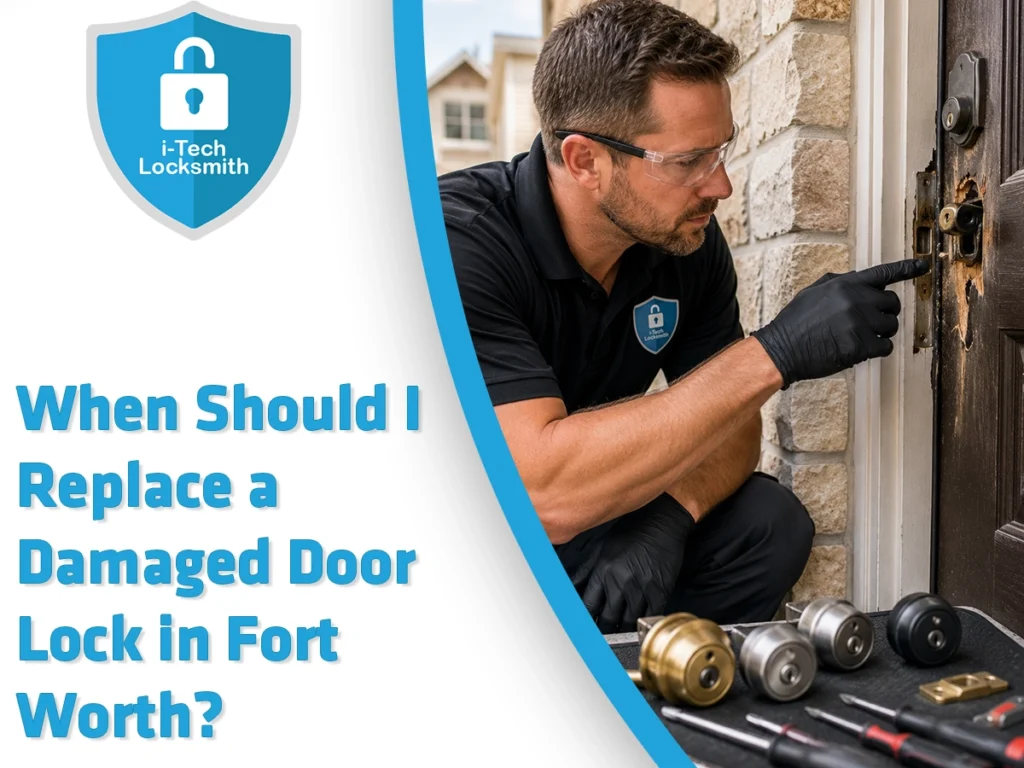
Signs Your Door Lock Needs Fast Replacement
A damaged lock can still turn, click, and appear normal while failing to secure the door correctly. Therefore, the safest time to replace a damaged door lock in Fort Worth is often before the lock stops working completely.
AI Overview
You should replace a damaged door lock in Fort Worth when the cylinder is loose, the key no longer turns reliably, the deadbolt does not extend fully, or the hardware has visible damage. Replacement is also wise after forced entry, severe corrosion, repeated lockouts, internal failure, or damage that prevents the door from latching securely.
However, not every lock problem requires complete replacement. A loose screw, minor alignment issue, worn key, or dirty cylinder may sometimes be corrected through adjustment or repair. Rekeying may also be suitable when the hardware remains safe but key control has been lost.
The correct choice depends on the complete door opening. A locksmith should inspect the cylinder, latch, deadbolt, strike plate, door frame, hinges, and alignment before recommending repair or replacement. A new lock will not solve a cracked frame or badly misaligned door by itself.
Businesses must also protect required exit routes. OSHA states that workplace exit routes must remain free and unobstructed, so replacement hardware must not prevent safe exit from inside an occupied building.
1. Replace the Lock When It No Longer Secures the Door
The clearest reason to replace a damaged lock is simple. The lock no longer keeps the door securely closed.
A lock may appear to engage while the bolt enters only part of the strike plate. Likewise, a latch may click without holding the door firmly.
Immediate warning signs include:
- The deadbolt does not extend completely
- The latch slips out when the door is pushed
- The cylinder turns without moving the bolt
- The door opens even though the lock appears engaged
- The lock cannot be secured from one side
Do not rely on a lock that works only after lifting, pulling, or pushing the door. That behavior often indicates alignment problems, worn hardware, or both.
First, test the lock with the door open. Then, test it again after closing the door. If the lock operates while open but fails when closed, door alignment may be part of the problem.
However, repeated force can damage internal parts. Therefore, stop forcing the key when the bolt will not move normally.
Replacement becomes more likely when:
- Internal movement has become unreliable
- The bolt no longer reaches its full position
- The lock has already failed several times
- Adjustment does not restore safe operation
CISA advises organizations to report broken doors, windows, and locks as soon as possible. It also recommends controlling and inventorying keys and other access items.
2. Act Quickly After Forced Entry Damage
A lock should receive immediate inspection after a break in or attempted forced entry. Even when the door still locks, hidden damage may reduce its strength.
Forced entry can affect:
- The lock cylinder
- The deadbolt
- The latch
- The strike plate
- The screws
- The door frame
- The area around the lock
Visible marks may include scratches, bending, cracks, missing material, or movement around the cylinder. However, the most important damage may be inside the lock.
A forced cylinder may turn today but fail during the next use. Likewise, a bent deadbolt may not enter the strike fully.
After law enforcement releases the scene, avoid treating the cylinder as the only concern. The locksmith should inspect the complete door opening.
Replacement is often appropriate when:
- The cylinder was drilled, twisted, or pulled
- The deadbolt was bent during the incident
- The lock body moved inside the door
- Internal parts were damaged
- The hardware cannot be trusted under pressure
The frame may also need repair or reinforcement. Installing a strong new lock on a cracked frame leaves a major weakness.
For more guidance, review this article about whether to rekey or replace locks after a break in.
3. Replace a Loose or Moving Lock Cylinder
A lock cylinder should remain stable during normal use. It should not rotate, wobble, pull outward, or shift inside the door.
A loose cylinder can result from:
- Worn mounting parts
- Loose fasteners
- Improper installation
- Repeated heavy use
- Forced movement
- Damage inside the lock body
Sometimes, tightening the correct component may solve a minor problem. However, repeated movement often signals wear or damage that requires more than a quick adjustment.
Do not ignore a cylinder that becomes loose again soon after tightening. Recurring movement may indicate that the lock body, mounting plate, or threads can no longer hold correctly.
Replacement may be the safer option when:
- The cylinder will not remain tight
- The keyway changes position during use
- The cylinder pulls away from the door
- The lock body moves with the cylinder
- Parts are stripped or broken
A locksmith should remove and inspect the hardware before deciding. The goal is to identify why the cylinder moved rather than simply hiding the movement.
4. Replace a Lock That Repeatedly Jams
A jammed lock can leave someone outside or prevent the door from being secured. Therefore, repeated jamming should never become part of normal door use.
A key may jam because of:
- A worn key
- Internal cylinder wear
- Dirt or debris
- Bent components
- Door misalignment
- Corrosion
- Damage to the bolt
One isolated problem may not require replacement. For example, a damaged duplicate key may be the true cause.
However, replacement becomes more reasonable when:
- Several keys experience the same problem
- The key stops at the same point
- The lock requires increasing force
- The cylinder binds after adjustment
- The problem returns after service
Forcing the key can create a second problem by breaking it inside the cylinder. In addition, twisting with pliers can damage the keyway and internal parts.
If a key is already stuck, avoid repeated force. This guide explains what to consider when a key becomes stuck in a lock.
5. Replace the Lock When the Key Turns Without Working
A key should control the latch or deadbolt through connected internal parts. If the key turns without moving the bolt, something inside may be disconnected or broken.
Possible causes include:
- A damaged tailpiece
- A broken cam
- A failed internal connection
- A stripped component
- A broken lock body
- Incorrect installation
This problem can create false confidence. The user may feel the key turn and assume the door is secure, even though the bolt did not move.
Check the bolt position visually whenever possible. Then, test the door without applying excessive force.
Replacement should be considered when:
- The key rotates freely
- The thumb turn moves without operating the bolt
- The lock works only from one side
- Internal parts no longer connect
- Replacement parts are unavailable
A professional inspection is especially important on an exterior door. A temporary improvement should not be mistaken for a reliable repair.
6. Replace Severe Rust and Corrosion
Exterior locks face rain, humidity, dirt, temperature changes, and daily handling. Over time, moisture can affect the finish and internal movement.
Surface discoloration alone may not mean the lock has failed. However, deep rust or corrosion can damage moving parts.
Warning signs include:
- Flaking metal
- Deep rust around the keyway
- A rough or gritty key movement
- A bolt that drags
- Parts that no longer move freely
- Corrosion between the lock and door
Replacement becomes more likely when corrosion has entered the cylinder or latch. Cleaning the surface will not restore metal that has weakened or changed shape.
Fort Worth weather can also expose exterior hardware to strong rain, heat, and changing conditions. Therefore, exterior locks should be inspected after major water exposure or when operation changes.
These related guides explain how to weatherproof lock hardware and how rain can place Fort Worth locks at risk.
7. Replace Cracked, Bent, or Broken Lock Parts
Visible structural damage usually deserves prompt attention. A crack or bend can prevent the lock from handling normal pressure.
Inspect these areas:
- The exterior cylinder
- The interior thumb turn
- The lever or knob
- The latch face
- The deadbolt
- The mounting plate
- The strike plate
A loose decorative cover may not affect security. However, a crack in a load bearing or operating component is different.
Replacement is normally safer when:
- The bolt is visibly bent
- The housing is cracked
- The thumb turn is broken
- The lever separates from the lock
- The latch face is damaged
- The mounting area cannot hold the hardware
Do not glue, tape, or brace a security component as a permanent fix. Those methods may hold a part in place without restoring safe operation.
BHMA standards evaluate builders hardware through factors such as operation, strength, durability, security, finish, and cycle performance. Product grades represent progressive performance levels, with Grade 1 being the highest within many standards.
8. Replace the Lock After Repeated Repairs
A repair may be worthwhile when the problem is small and the remaining hardware is sound. However, repeated repair costs can exceed the value of keeping an unreliable lock.
Consider the history of the lock:
- How often has it failed?
- Which parts were repaired?
- Does the same problem return?
- Are replacement parts still available?
- Has the door caused repeated lock damage?
One repaired screw does not mean the lock needs replacement. In contrast, several service calls for sticking, loosening, and internal failure suggest a wider problem.
Replacement may offer better value when:
- Reliability continues to decline
- Repair parts are difficult to find
- The lock design is no longer suitable
- The hardware causes recurring lockouts
- The repair does not address the root cause
The decision should compare repair cost, hardware condition, and expected reliability. It should not depend only on the price of one replacement part.
This article explains the wider cost of ignoring a faulty lock.
9. Replace Outdated Locks That No Longer Fit the Risk
A lock may still function but no longer provide the features needed for the property. This issue is common when ownership, occupancy, or security needs change.
An older lock may lack:
- Suitable strength for the door
- Good key control
- Available replacement parts
- Compatibility with current hardware
- The access features now required
- Reliable performance after years of use
Age alone does not prove that replacement is necessary. Some older commercial and residential locks remain dependable when maintained properly.
However, an outdated lock should be reviewed when:
- Keys can no longer be controlled
- The cylinder has significant wear
- Parts have been discontinued
- The property now protects higher value items
- The door has become a primary entrance
- The current hardware is the wrong grade or function
The locksmith should explain the practical benefit of an upgrade. A more expensive lock is not automatically the best choice for every door.
10. Replace the Lock When Rekeying Cannot Fix the Damage
Rekeying changes which key operates a compatible cylinder. It does not repair structural damage, deep corrosion, broken parts, or a failing lock body.
Rekeying may be suitable when:
- A key was lost
- A tenant or employee moved out
- Unknown copies may exist
- The hardware remains safe
- The cylinder still works correctly
Replacement is more appropriate when:
- The cylinder is damaged
- Internal parts are failing
- The lock is incompatible
- The housing is cracked
- The hardware no longer secures the door
This difference prevents a common misunderstanding. A newly keyed cylinder is not necessarily a repaired cylinder.
A locksmith should first determine whether the problem involves access control, mechanical condition, or both.
For a detailed comparison, read this guide to rekeying versus replacing locks.
11. Replace Locks That No Longer Match the Door
Sometimes the lock is not the only damaged part. A door may sag, swell, shift, or pull away from the frame.
These changes can cause:
- A latch that misses the strike
- A deadbolt that rubs
- A key that becomes hard to turn
- A door that must be lifted
- A lock that fails only when closed
Replacing the lock without correcting alignment may damage the new hardware. Therefore, the door should be tested before any final recommendation.
The locksmith should examine:
- Hinges and hinge screws
- Door movement
- Frame condition
- Strike position
- Bolt clearance
- Door closing pressure
Adjustment may solve the problem when the existing lock remains sound. However, replacement may still be needed when repeated misalignment has bent or worn the lock.
The best result may involve both door adjustment and new hardware.
12. Replace Damaged Exit Door Hardware Carefully
Commercial exit doors require special attention. A replacement must secure the property without preventing safe exit.
OSHA requires workplace exit routes to remain free and unobstructed. Exit route doors must allow employees to open them from inside without keys, tools, or special knowledge in the situations covered by the standard.
Damaged exit hardware may include:
- A sticking panic bar
- A failed exit latch
- Broken exterior trim
- A loose cylinder
- A door that will not relatch
- A closer that prevents proper closing
Businesses should not add improvised locks, chains, bars, or secondary devices that could block exit.
Instead, a qualified professional should inspect:
- The exit device
- Door operation
- Latching
- Exterior access
- Closing speed
- Required release function
Complex work may require coordination with door, fire, alarm, or access control professionals. The lock replacement must fit the complete life safety system.
13. Replace a Damaged Smart Lock When Core Functions Fail
Smart locks add electronic parts to the normal locking process. Therefore, a problem may involve software, batteries, the motor, the deadbolt, or door alignment.
Before replacing the complete unit, check:
- Battery condition
- Battery contacts
- Door alignment
- Manual key operation
- Deadbolt movement
- Approved reset procedures
Replacement may be necessary when:
- The motor no longer moves the bolt
- The housing is cracked
- Moisture entered the electronics
- The manual override fails
- The unit repeatedly loses power
- The product is no longer supported
Do not assume every connection issue means the physical lock is broken. Likewise, do not assume a working app means the door is secure.
Test the deadbolt position and manual operation. Then, verify whether the lock actually secures the door.
14. Replace the Lock Before It Causes an Emergency Lockout
Many locks show warning signs before complete failure. Addressing those signs early can reduce the chance of being locked outside.
Early warnings include:
- A key that needs extra movement
- A latch that returns slowly
- A cylinder that feels rough
- A deadbolt that stops partway
- A lever that does not return
- A problem that changes with weather
Schedule an inspection before the lock becomes impossible to use. This is especially important for:
- Main business entrances
- Rental properties
- Homes with one primary entrance
- Doors used by older adults
- Doors protecting critical equipment
- Properties with limited after hours access
A planned replacement allows time to compare hardware, review pricing, and distribute new keys. An emergency replacement offers fewer choices because the door must be secured quickly.
15. Choose the Replacement Lock for the Actual Door
A replacement should match the door, property, use level, and access needs. Choosing only by appearance or price can lead to poor performance.
The locksmith should consider:
- Residential or commercial use
- Door material
- Door thickness
- Existing preparation
- Traffic level
- Exposure to weather
- Required key control
- Exit function
BHMA publishes standards covering locks, latches, mortise locks, closers, exit devices, access control products, and other builders hardware. Its standards use testing criteria suited to specific product categories.
Ask the locksmith to explain:
- The proposed lock function
- The product grade
- Key duplication controls
- Compatibility with the door
- Expected maintenance
- Whether the strike needs work
The goal is not to install the most complicated lock. The goal is to install hardware that works reliably and fits the opening.
16. Know When a Repair May Still Be Enough
Replacement is not always required. A qualified inspection may find that the main hardware remains safe.
Repair or adjustment may be enough when:
- A fastener is loose but undamaged
- The strike needs minor alignment
- A worn key caused the issue
- The cylinder needs approved maintenance
- The door shifted slightly
- A replaceable part failed
However, the repaired lock must be tested completely. It should work with the door open and closed.
A proper test includes:
- Smooth key movement
- Full bolt extension
- Secure latching
- Stable hardware
- Correct inside operation
- Reliable repeated use
If the same failure returns, replacement may offer better long term value.
17. Use a Practical Repair or Replacement Checklist
Homeowners and business managers can use a simple checklist before approving work.
Consider repair when:
- Damage is minor
- The lock remains structurally sound
- Parts are available
- The issue has a clear repairable cause
- The repair restores reliable operation
Consider replacement when:
- The lock was forced
- Internal parts are broken
- The cylinder moves or pulls out
- Corrosion is severe
- The key turns without moving the bolt
- Repairs keep failing
- The hardware no longer fits the risk
Also inspect the door and frame. A complete decision should address the full opening rather than one visible part.
18. A Practical Fort Worth Lock Damage Example
Consider a hypothetical Fort Worth property with an exterior deadbolt that has become difficult to turn.
The owner notices:
- The key works when the door is open
- The deadbolt sticks when the door is closed
- The strike plate shows fresh rubbing
- The cylinder remains stable
In that case, alignment may be the primary issue. Adjustment could restore safe operation if the lock itself remains undamaged.
Now consider a different situation:
- The cylinder moves inside the door
- The key turns without extending the bolt
- The housing has pry marks
- The frame is cracked
That condition would support a wider repair plan. The lock would likely need replacement, while the frame would also require attention.
These examples show decision methods. They do not describe verified I-Tech Locksmith – Fort Worth customers.
19. Choose a Fort Worth Locksmith Carefully
A locksmith may receive access to a home, office, store, or restricted room. Therefore, the provider should verify authority and explain the work clearly.
Ask the locksmith to:
- Inspect before drilling
- Identify the actual failure
- Explain repair and replacement options
- Provide clear pricing
- Protect the door and frame
- Test the completed lock
- Provide an itemized invoice
Avoid providers who:
- Refuse to describe the work
- Recommend drilling immediately
- Give vague total costs
- Push unnecessary upgrades
- Replace parts without approval
- Leave without testing the door
Consumer protection advice from the FTC recommends watching for common scam warning signs and protecting personal and financial information. Those general precautions are useful when selecting any urgent service provider.
Frequently Asked Questions
Can a damaged door lock be repaired instead of replaced?
Some damaged locks can be repaired when the issue involves loose fasteners, minor alignment, a replaceable part, or a worn key. However, replacement is usually safer when the cylinder, housing, bolt, or internal mechanism has structural damage. A locksmith should inspect the complete door before making the decision.
How do I know whether my deadbolt is damaged?
Common signs include a bolt that stops partway, a key that requires force, a loose cylinder, visible bending, or a thumb turn that moves without operating the bolt. Test the deadbolt with the door open and closed. Different results may indicate both alignment and hardware problems.
Should I replace a lock after someone tried to break in?
The lock should be inspected promptly after attempted forced entry. Replacement is often appropriate when the cylinder was twisted, drilled, pulled, bent, or loosened. The strike plate, screws, door, and frame should also be checked because replacing only the cylinder may leave other damage unresolved.
Is rekeying enough for a damaged lock?
Rekeying is enough only when the cylinder remains safe and functional but the business or homeowner needs different keys. Rekeying does not repair broken parts, deep corrosion, cracks, loose housings, or severe wear. A physically damaged lock may need repair or complete replacement.
How quickly should I replace a failing exterior lock?
An exterior lock should be assessed as soon as it stops securing the door reliably. Immediate service is important when the bolt does not extend, the cylinder moves, the door can be pushed open, or forced entry caused damage. Temporary measures should not replace a proper repair.
Conclusion
You should replace a damaged door lock in Fort Worth when the hardware can no longer secure the door consistently. Serious warning signs include a loose cylinder, broken internal parts, severe corrosion, visible cracks, forced entry damage, and repeated mechanical failure.
However, not every sticking lock needs complete replacement. A worn key, minor strike issue, loose fastener, or door alignment problem may sometimes be repaired.
The correct decision begins with a complete inspection. The locksmith should test the lock with the door open and closed. In addition, the cylinder, latch, deadbolt, strike plate, frame, and hinges should be checked.
Rekeying may solve a key control problem when the hardware remains sound. However, rekeying cannot restore damaged metal or broken internal parts.
A new lock should also match the door and its daily use. Residential entrances, commercial doors, exit routes, storefronts, and smart locks may require different products and installation methods.
Most importantly, do not wait for total failure when the warning signs are already clear. A planned replacement can reduce lockout risk, provide time for a proper inspection, and help protect the door before the damage becomes worse.
Contact I-Tech Locksmith – Fort Worth
Protect your property with a lock assessment based on the actual condition of your door and hardware.
I-Tech Locksmith – Fort Worth can inspect the cylinder, deadbolt, latch, strike plate, and frame. The technician can then explain whether repair, rekeying, adjustment, or complete replacement is the most practical option.
Contact us at
Phone: 817-663-0642
Location: 8520 Tamar Trail, Fort Worth, TX 76118
Website: www.i-tech-locksmith.com