
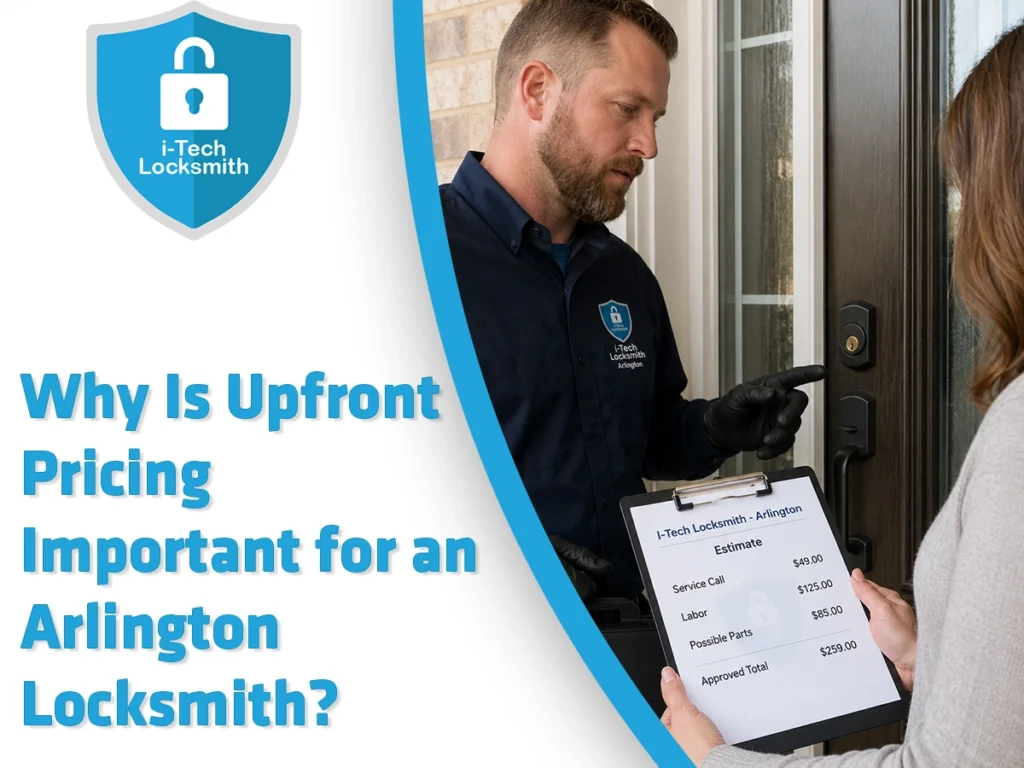
17 Powerful Reasons Clear Pricing Protects Every Customer
A very low locksmith quote may become much higher after the technician arrives or finishes the work. ALOA warns that dishonest operators may advertise a price that seems too good to be true and then raise it substantially after gaining the customer’s commitment.
AI Overview
Upfront locksmith pricing in Arlington helps customers understand what they may pay before a technician begins work. A clear estimate should identify the service call charge, expected labor, possible parts, after hours fees, payment terms, and circumstances that could change the total.
The final price cannot always be confirmed during the first phone call. The dispatcher may not know the lock type, internal damage, door condition, vehicle security system, or required replacement part. However, the company should still explain how pricing works and provide a reasonable estimate based on the information available.
After inspecting the lock, the technician should explain the problem and provide an updated price before beginning the approved service. If hidden damage appears later, the technician should stop, explain the new finding, and receive permission before adding work or costs.
This process protects customers from surprise charges. It also protects responsible locksmith companies because both parties understand the scope, method, and expected result.
The Federal Trade Commission recommends obtaining written estimates and reviewing agreements before repair work begins. Texas also regulates locksmiths through the Texas Department of Public Safety private security program.
1. Upfront Pricing Helps Customers Make an Informed Choice
A customer cannot compare locksmith services without understanding what each quoted price includes.
One company may quote only a service call. Another may include entry labor. A third may include the service call, labor, and a standard replacement part.
Therefore, customers should ask whether the estimate covers:
- Travel or service call charges
- Inspection and diagnosis
- Labor for the requested service
- Parts that may be required
- After hours or weekend fees
- Taxes and payment charges
A clear estimate allows the customer to compare the complete service instead of comparing two numbers that represent different things.
For example, a low quote may sound attractive. However, it provides little value when it excludes labor, drilling, hardware, or nighttime service.
Before booking, ask:
- Is this the expected total or only a starting price?
- What service does the quoted amount include?
- What conditions could increase the total?
- Are parts included?
- Is there an after hours charge?
- Will I receive a written estimate after inspection?
An honest answer may include a range. That does not make the estimate unreliable. In fact, a realistic range may be more useful than an exact promise made without seeing the lock.
2. Clear Pricing Reduces Bait and Switch Risk
A bait and switch pricing tactic begins with an unusually low amount. After the technician arrives, the customer learns that the quoted price covered almost nothing.
Possible added charges may include:
- A separate service call
- Additional labor
- Drilling
- Lock removal
- New hardware
- Key cutting
Some added charges can be valid. However, they should be explained before work begins.
ALOA identifies the pattern of advertising a very low amount and then raising the price after arrival or completion as a common locksmith scam warning sign.
A clear pricing process should include three stages:
- An initial estimate during dispatch
- A confirmed estimate after inspection
- Customer approval before added work
Customers should be cautious when a provider:
- Repeats only a very low starting price
- Avoids questions about labor
- Refuses to explain service fees
- Gives the same quote for every lock
- Will not discuss parts
- Says the final price will be revealed afterward
Upfront pricing does not guarantee that no changes will occur. However, it requires the provider to explain changes before creating additional cost.
3. A Written Estimate Creates a Clear Record
Verbal conversations are easy to misunderstand. A written estimate gives the customer and technician a shared record of the approved service.
A useful estimate should identify:
- The locksmith company
- The customer or service location
- The requested work
- The service call charge
- Expected labor
- Proposed parts
- The estimated total
It should also explain whether the amount is:
- A fixed price
- An estimated range
- A minimum charge
- Subject to inspection
- Based on standard hardware
- Limited to one service
The FTC advises consumers to obtain written estimates and review the agreement before repair work begins.
Do not sign a blank form. Likewise, do not approve a document that leaves the total, service, or parts unclear.
When the scope changes, request a revised written estimate.
The revised document should explain:
- What additional problem was discovered
- Why the original scope is no longer enough
- Which additional part or service is needed
- How much the added work costs
- What the new total will be
4. Upfront Pricing Separates the Service Call From Labor
Many mobile locksmith businesses charge for dispatching a technician to the customer’s location. This charge may apply even when the customer declines the recommended work.
Therefore, ask whether a service call fee applies.
The service call may cover:
- Technician travel
- Mobile equipment
- Time spent reaching the property
- Initial inspection
- Administrative costs
- After hours dispatch
Labor is usually separate because the amount of work depends on the problem.
Possible labor services include:
- Unlocking a door
- Extracting a broken key
- Rekeying a cylinder
- Replacing a lock
- Cutting a vehicle key
- Programming a key fob
A customer should know whether the service call becomes part of the final total or remains an additional charge.
Ask:
- Is the service call included in the quoted amount?
- Does the fee apply if I decline the work?
- Is the inspection included?
- Does travel distance affect the charge?
- Is there an extra nighttime fee?
- Will the fee appear on the invoice?
Clear answers prevent the customer from believing that a dispatch fee represents the complete service price.
5. Transparent Estimates Explain Labor Costs
Labor can vary because locksmith problems differ in difficulty, equipment, and time.
A simple rekey may require less work than a damaged commercial mortise lock. Likewise, basic vehicle entry differs from creating and programming a new smart key.
Labor may depend on:
- Lock type
- Door or vehicle design
- Existing damage
- Required disassembly
- Security level
- Programming procedures
A clear estimate should connect the labor cost to the service being performed.
For example, the technician may explain that the price includes:
- Removing the cylinder
- Changing internal components
- Cutting new keys
- Reinstalling the lock
- Testing every key
- Confirming the old key fails
Customers should not need advanced locksmith knowledge. However, they should understand what the labor is intended to accomplish.
A professional explanation also helps prevent unnecessary work. When the customer understands the service, it becomes easier to question a recommendation that does not match the problem.
6. Pricing Should Identify Expected Parts
Locksmith work may require replacement parts. Those parts should be identified before installation whenever possible.
Common parts include:
- Lock cylinders
- Deadbolts
- Latches
- Commercial levers
- Key blanks
- Vehicle key fobs
Ask the technician to explain:
- The part brand
- The part type
- Whether the part is new
- The number of included keys
- The product warranty
- Why replacement is needed
A replacement recommendation should match the inspection.
For example, lost key control may require rekeying rather than a complete new lock. Conversely, a cracked cylinder may require replacement because rekeying cannot restore damaged metal.
This guide to rekeying versus replacing locks explains how these services solve different problems.
The estimate should separate:
- Part cost
- Installation labor
- Additional key cost
- Programming cost
- Disposal charges
- Optional upgrades
7. Upfront Pricing Prevents Unapproved Drilling Costs
Drilling may be necessary when a lock has failed, suffered damage, or cannot be opened through a reasonable alternative.
However, drilling should not begin without an explanation.
Before approving drilling, ask:
- Why is drilling necessary?
- Which other methods were considered?
- Which part will be damaged?
- Will the complete lock need replacement?
- What replacement hardware will be used?
- What will the new total cost be?
Drilling often creates additional costs because the damaged cylinder or lock may no longer remain usable.
Therefore, the estimate should cover both:
- The drilling or removal work
- The required replacement hardware
Be cautious when a technician immediately recommends drilling without inspecting the cylinder, door, or existing damage.
A professional locksmith should connect the proposed method to the actual condition.
Clear pricing allows the customer to approve the complete consequence of drilling instead of approving one action without knowing the replacement cost.
8. Emergency Customers Need Pricing Clarity Most
A person locked outside may feel rushed, worried, or unsafe. Unfortunately, that pressure can make it difficult to review pricing.
Emergency callers should still ask:
- What is the dispatch charge?
- What is the expected labor range?
- Is there an after hours fee?
- What could increase the price?
- Will drilling require replacement?
- Which payment methods are accepted?
A responsible dispatcher should ask questions about the problem.
Useful questions may include:
- Is this a home, vehicle, or business?
- Is the key lost or locked inside?
- Is the lock damaged?
- What type of door or vehicle is involved?
- Is the key broken?
- Is someone in immediate danger?
These questions help create a more useful estimate.
If a child, vulnerable person, fire, medical issue, or immediate threat is involved, call emergency services rather than waiting for routine locksmith assistance.
For non emergency situations, review these steps to take during a lockout.
9. Residential Pricing Should Match the Lock Problem
Residential locksmith work may involve entry, rekeying, repair, replacement, or key cutting.
Each service has a different purpose.
A house lockout estimate may include:
- Service call
- Entry labor
- Inspection
- Possible drilling
- Replacement hardware
- Additional keys
A rekey estimate may include:
- Cylinder removal
- Internal changes
- New keys
- Reinstallation
- Testing
- Additional cylinders
A lock replacement estimate may include:
- New hardware
- Removal of the old lock
- Installation
- Door preparation
- Strike adjustment
- Final testing
The technician should not treat every residential problem as complete replacement.
For example:
- A lost key may support rekeying
- A loose screw may require adjustment
- A cracked cylinder may require replacement
- Poor alignment may require door correction
- A worn key may require a new key
- Forced entry may require wider repairs
The estimate should reflect the actual diagnosis.
10. Automotive Pricing Needs Detailed Information
Automotive locksmith prices can vary widely because vehicle keys and security systems differ.
A dispatcher may need:
- Vehicle make
- Vehicle model
- Model year
- Vehicle identification number
- Current key type
- Number of working keys
Automotive services may include:
- Vehicle entry
- Mechanical key cutting
- Transponder programming
- Smart key pairing
- Broken key extraction
- Ignition diagnosis
A complete estimate should explain whether it includes:
- The replacement key or fob
- Emergency blade cutting
- Electronic programming
- Mobile travel
- Vehicle entry
- Final function testing
A low price may cover only entry or programming. It may not include the key, blade, or service call.
Therefore, customers should ask for a breakdown.
ALOA explains that modern locksmith services can extend beyond basic entry and include automotive key and security work.
11. Commercial Customers Need a Defined Scope
Commercial locksmith projects may include several doors, access levels, and hardware types.
Before quoting, the locksmith may need to inspect:
- Exterior entrances
- Interior offices
- Storefront locks
- Master key systems
- Exit hardware
- Electronic access equipment
A commercial estimate should identify:
- Number of doors
- Number of cylinders
- Hardware being repaired
- Hardware being replaced
- Number of keys
- Access levels
The estimate may also explain:
- Work schedule
- Business disruption
- Employee access changes
- Testing process
- Record updates
- Future service needs
A vague per lock price may not describe a complex commercial project accurately.
Instead, the business should receive a clear scope showing which opening receives each service.
That process helps decision makers compare proposals and control the project budget.
12. Upfront Pricing Helps Customers Compare Rekeying and Replacement
Rekeying and replacement may solve different concerns.
Rekeying is often considered when:
- A key is lost
- An employee leaves
- A tenant changes
- Unknown copies may exist
- The hardware remains safe
- New key control is needed
Replacement may be considered when:
- The cylinder is damaged
- Internal parts have failed
- Severe corrosion exists
- The lock is outdated
- Forced entry caused damage
- The hardware no longer fits the risk
The estimate should show the cost difference between these choices when both remain valid.
A clear comparison may include:
- Rekeying cost
- Replacement cost
- Number of new keys
- Hardware quality
- Expected service life
- Optional upgrades
The least expensive option is not always the best value. However, the customer should understand why a more costly option is recommended.
13. A Clear Estimate Identifies After Hours Fees
Emergency service during nights, weekends, or holidays may involve a different rate.
The provider should disclose that possibility before dispatch.
Ask:
- Does an after hours fee apply?
- When does the higher rate begin?
- Is the fee fixed?
- Is it included in the quote?
- Does a holiday rate apply?
- Does distance affect the price?
Do not assume that 24 hour availability means the same price applies all day.
A clear company will explain:
- Normal service hours
- After hours periods
- Weekend pricing
- Holiday pricing
- Emergency dispatch charges
- Possible travel fees
The customer can then decide whether the service must happen immediately or can wait until normal hours.
However, a door that cannot be secured may require urgent attention even when the customer is not locked out.
14. Price Changes Should Require New Approval
An estimate may change after the technician discovers hidden damage.
For example:
- A cylinder may be broken internally
- A deadbolt may be bent
- A vehicle fob may be incompatible
- A commercial lock body may have failed
- A door frame may require separate repair
- A replacement part may be unavailable
A legitimate change should follow a clear process.
The technician should:
- Stop the unapproved work
- Show or explain the finding
- Identify the additional service
- State the additional price
- Update the total
- Receive customer approval
The customer should not learn about the increase only after the work is finished.
Do not approve vague additions such as special labor without an explanation.
Ask what changed and why the new work is necessary.
15. Transparent Payment Terms Protect Both Parties
Before work begins, customers should know which payment methods the company accepts.
Possible methods include:
- Credit card
- Debit card
- Cash
- Business check
- Approved digital payment
- Commercial account billing
The FTC warns consumers to be cautious when a provider demands payment through methods that are difficult to reverse, including wire transfers and certain urgent cash demands.
Before paying, confirm:
- The invoice matches the estimate
- The company name is correct
- Parts are listed
- Added work was approved
- Taxes are explained
- A receipt will be provided
Payment should go to the company or clearly identified authorized provider.
Be cautious when the payment recipient has no clear connection to the locksmith company.
16. Texas Licensing Adds Another Verification Step
Texas includes locksmiths within the private security profession regulated by the Department of Public Safety.
The Texas DPS states that it regulates locksmiths and other private security professionals under Texas law and related administrative rules.
Customers can ask:
- What is the company’s licensed name?
- Is the technician affiliated with the licensed company?
- Can the provider supply license information?
- Does the invoice use the same company name?
- Where can the information be verified?
- Who handles complaints?
Texas DPS also provides licensing and registration resources through its Private Security program.
Licensing does not replace the need for an estimate. However, it gives customers another way to verify who is providing the service.
17. An Itemized Invoice Confirms What Was Completed
The final invoice should reflect the approved estimate and actual completed work.
A useful invoice may include:
- Service call
- Labor
- Entry service
- Rekeying
- Replacement parts
- New keys
It may also include:
- Key programming
- After hours fee
- Taxes
- Approved extra work
- Warranty information
- Payment record
Review the invoice before paying.
Check whether:
- The company name is correct
- Each charge is understandable
- Installed parts are listed
- The total matches the agreement
- Added services were approved
- A receipt is provided
Keep the estimate, invoice, and receipt. These records may help with warranty work, insurance questions, business accounting, or a payment dispute.
18. Upfront Pricing Builds Customer Trust
A locksmith works around homes, vehicles, businesses, keys, and access systems. Therefore, trust is essential.
Clear pricing shows respect for the customer’s:
- Budget
- Property
- Time
- Safety
- Right to choose
- Need for accurate information
It also helps the locksmith because the customer understands:
- What work is approved
- What parts may be installed
- What result is expected
- What the service may cost
- Which changes require approval
- When payment is due
Trust does not come from promising the lowest price.
Instead, it grows from:
- Accurate communication
- Honest inspection
- Clear estimates
- Professional identification
- Approved work
- Reliable testing
ALOA advises consumers to hire carefully because locksmiths may work on homes, vehicles, businesses, and areas containing valuable or sensitive property.
19. Use an Upfront Pricing Checklist
Before dispatch, ask:
- What is the company name?
- What is the service call charge?
- Is the quote a total or starting price?
- Is there an after hours fee?
- What may increase the price?
- Which payment methods are accepted?
At arrival, confirm:
- Technician identity
- Company affiliation
- Requested service
- Inspection findings
- Proposed method
- Written estimate
Before work begins, confirm:
- Labor cost
- Parts cost
- Drilling cost
- Replacement cost
- Approved total
- Warranty terms
After completion, confirm:
- The lock or key works
- Every new key is tested
- Installed parts match the estimate
- The final invoice is itemized
- The payment recipient is correct
- A receipt is provided
20. A Practical Arlington Pricing Example
Consider a hypothetical Arlington homeowner who is locked outside after a key stops turning.
During the call, the dispatcher explains:
- The service call charge
- The expected entry range
- Possible after hours fees
- Factors that may change the price
- Accepted payment methods
- The need for inspection
After arriving, the technician finds that the lock works but the door is misaligned.
The technician then provides a written estimate for:
- Entry
- Minor alignment work
- Lock testing
- No replacement hardware
Now consider a different situation where the cylinder is cracked and cannot remain secure.
The technician should explain:
- Why the cylinder cannot be repaired
- Which replacement is recommended
- The cost of the part
- The installation labor
- The number of included keys
- The revised total
These examples show a transparent pricing process. They do not describe verified I-Tech Locksmith – Arlington customers.
Frequently Asked Questions
Should a locksmith give me a price before arriving?
A locksmith should explain the service call fee and provide a reasonable estimate or range based on the information available. The final total may require an onsite inspection because lock types and damage vary. However, the technician should confirm the price before beginning approved work.
Why can a locksmith estimate change after inspection?
An estimate may change when the technician discovers hidden damage, unusual hardware, a failed internal part, or an incompatible replacement. The technician should explain the new finding, identify the added service, state the added cost, and receive approval before continuing.
What should a written locksmith estimate include?
A written estimate should list the company, service call, labor, expected parts, after hours fees, taxes, payment terms, and estimated total. It should also explain which conditions could change the price and whether the customer owes a service fee after declining the work.
Is the cheapest Arlington locksmith always the best choice?
No. An unusually low quote may exclude labor, parts, drilling, or the service call. Compare complete estimates rather than starting prices. Also verify the company, licensing information, technician identity, service method, payment terms, warranty, and invoice process before approving work.
Can I refuse additional locksmith charges?
You can decline work that you have not approved. When hidden damage requires additional service, the technician should stop and explain the revised scope and price. However, you may still owe a service call or completed labor charge that was clearly disclosed and approved earlier.
Conclusion
Upfront locksmith pricing in Arlington helps customers understand the service, compare providers, control costs, and avoid surprise charges.
The first phone quote may not always be the final price. A dispatcher may not know the exact lock type, internal damage, door condition, vehicle system, or required part.
However, the provider should still explain the service call, expected labor, possible parts, after hours charges, payment terms, and factors that may change the total.
After inspection, the technician should provide a clear estimate before beginning work. The customer should understand the problem, proposed method, parts, labor, and expected result.
Drilling and replacement should receive specific approval because they can create additional costs. Likewise, hidden damage should be explained before the technician performs added work.
A transparent locksmith should also verify the customer’s right to enter, identify the company, explain payment options, test the completed service, and provide an itemized invoice.
The lowest advertised price is not always the best value. A clear and realistic estimate provides more protection than a vague promise designed only to secure the service call.
Most importantly, customers should never feel pressured to approve unclear pricing. Ask questions, request written details, and approve only the service that you understand.
Contact I-Tech Locksmith – Arlington
I-Tech Locksmith – Arlington can inspect residential, automotive, and commercial lock problems before explaining the available service options and expected pricing.
The technician can identify the lock issue, describe the proposed method, discuss possible parts, and provide an estimate before approved work begins.
Contact us at
Phone: 817-383-1387
Location: 1738 W Division St, Arlington, TX 76012
Website: www.i-tech-locksmith.com